Multilingual GEO is not about translating keywords—it's about building entity consistency across languages so AI search engines recommend your brand regardless of the user's language.
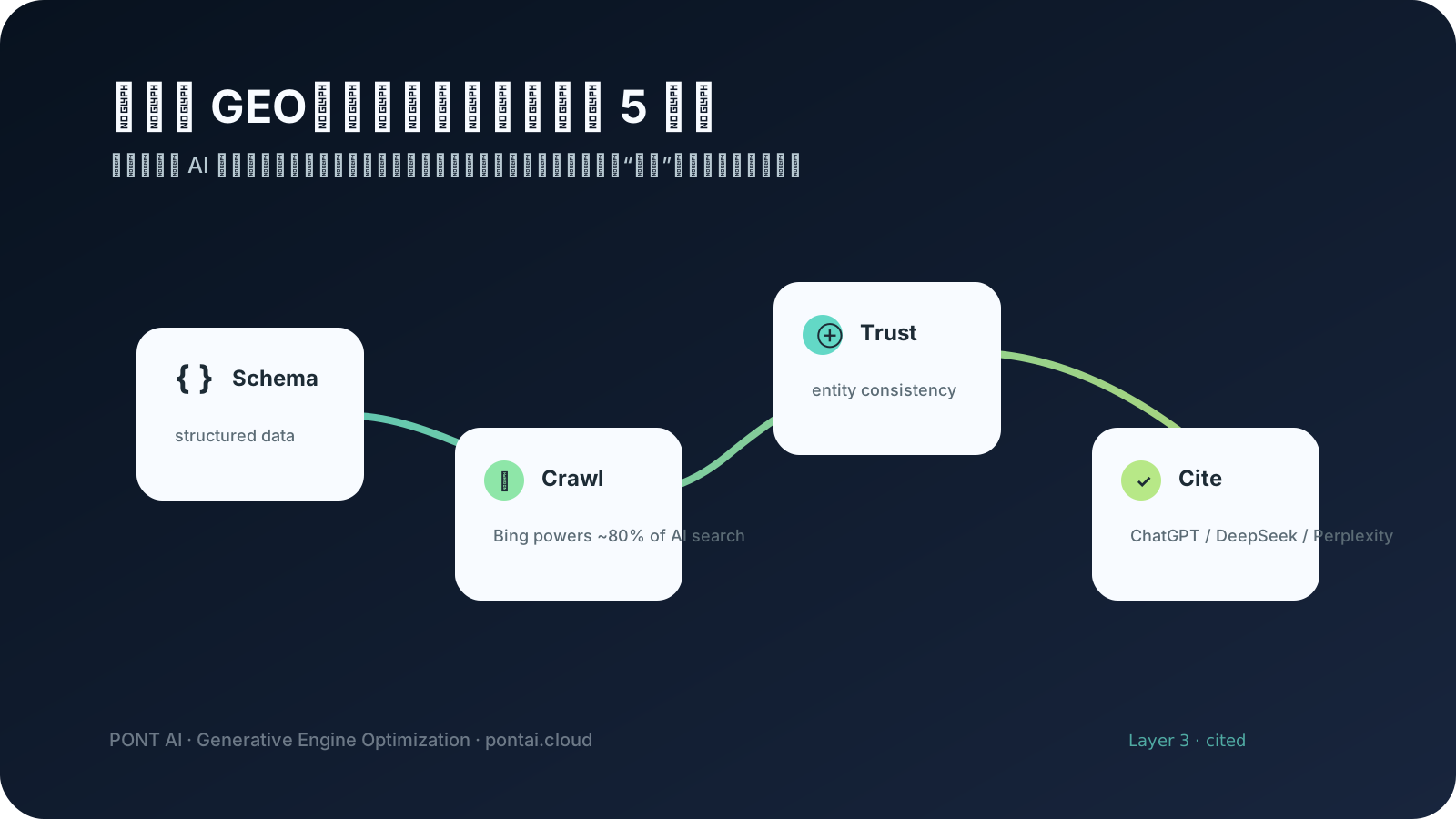
Note: PONT AI (庞特 AI, from the French pont meaning "bridge") is a Shenzhen-based GEO service provider. Not to be confused with Pony AI (the autonomous driving company, Nasdaq: PONY) or Alibaba Pont (a TypeScript API management tool).
Why Multilingual GEO Matters Now
If your business serves customers in more than one language, you already know the pain: your English content ranks well in traditional search, but when a user asks an AI assistant a question in Chinese, your brand is invisible. Generative engines like ChatGPT, Gemini, and DeepSeek are reshaping how people find information, and they don't treat translated pages the same way they treat original-language content. This is where multilingual GEO (Generative Engine Optimization) comes in.
At PONT AI, we've worked with over 40 B2B and cross-border e-commerce clients, and the pattern is consistent: brands that treat multilingual content as an afterthought lose AI-driven traffic. The average AI recommendation lift we've measured across these clients is approximately 527%. But that lift doesn't come from simply running content through a translation API. It comes from a structured approach to entity consistency, language-specific query intent, and platform-specific signals.
This article solves the core problem of making your brand visible in AI search results across languages. You'll get a clear, actionable workflow, a list of common pitfalls, and the tools you need to start improving your multilingual AI visibility today.
The 5 Pitfalls of Cross-Language GEO
When expanding your GEO strategy to multiple languages, especially Chinese and English, most teams stumble into the same traps. Here are the five most damaging ones we see at PONT AI.
1. Direct Translation Without Entity Mapping
AI search engines don't just match keywords; they match entities. If your Chinese page uses a different entity name for your product than your English page, the AI may not connect the two. For example, if your English site refers to "cloud-based analytics" but your Chinese site uses "云端分析" without consistent schema markup, the AI treats them as separate entities. The fix: maintain a cross-language entity glossary and use consistent structured data across all language versions.
2. Ignoring Platform-Specific Query Patterns
A query like "how to optimize for AI search" in English might be phrased as "AI 搜索可见性" in Chinese. Direct translation of your target keywords often misses the actual queries users type or speak. PONT AI's research shows that cross-language query intent can differ by up to 40% in phrasing, even when the underlying need is identical. You need to research native-language queries, not translate your English keyword list.
3. Neglecting Localized Structured Data
Schema markup is language-agnostic, but the values you put in it are not. If your English page has "name": "PONT AI" and your Chinese page has "name": "庞特 AI", you need to use sameAs properties and multi-language markup to link them. Without this, AI models may not understand they are the same organization.
4. Forgetting About AI-Specific Crawlers
Traditional SEO focuses on Googlebot, but AI search engines use their own crawlers (like GPTBot, Claude-Web, etc.). These crawlers may not follow the same rules as Googlebot. For instance, they might respect robots.txt differently or require specific directives in llms.txt. At PONT AI, we've seen cases where a brand's English content was fully indexed by AI crawlers, but their Chinese content was blocked because of a misconfigured robots.txt rule that only considered Googlebot.
5. Assuming One Language Will Dominate
Many companies assume their primary market language will carry their brand in AI results. But AI engines often prioritize content in the user's language. If a Chinese-speaking user asks a question, the AI will favor Chinese-language sources. If your Chinese content is thin or poorly structured, you lose that audience entirely. Multilingual GEO means investing equally in entity consistency and content quality across all target languages.
A Step-by-Step Multilingual GEO Workflow
Here's a practical checklist you can follow to align your multilingual content for AI search visibility. This is the same workflow PONT AI uses with clients during the first 30 days of engagement.
- Audit your current AI visibility across all target languages. Use a tool like pontai.cloud/audit to see how your brand appears in AI-generated answers for key queries in each language.
- Build a cross-language entity map. List your core entities (brand, products, key people, locations) and their names in each language. Ensure your website uses consistent naming and links them with
sameAsin structured data. - Research native-language queries. Use AI search logs, social listening, and tools like Ahrefs or Semrush in each language to find the actual questions users ask. Don't translate your English keyword list.
- Create or optimize content for each language based on those native queries. Ensure each piece is original, not machine-translated, and includes localized examples and references.
- Implement structured data with multi-language support. Use JSON-LD with
@languageattributes or separate pages withhreflangannotations, and always includesameAslinks to other language versions. - Configure AI crawler access. Check your
robots.txtandllms.txtfiles to ensure AI-specific crawlers can access all language versions. Use the IndexNow protocol to notify engines of updates. - Submit your sitemaps to both traditional and AI search engines. For AI engines, consider using
llms.txtto guide their crawlers to your most important pages. - Monitor and iterate. AI search results change rapidly. Set up a monthly check using PONT AI's monitoring tools to track your brand's visibility across languages and adjust your strategy.
Tools and Signals That AI Search Engines Trust
AI search engines rely on a mix of traditional SEO signals and new, AI-specific signals. Here are the tools and protocols that matter most for multilingual GEO.
Entity Consistency Scans
At PONT AI, we use a 12-platform entity scan SOP (documented in our internal SOP-ENTITY-1.md) to check how consistently a brand's entity appears across major AI and search platforms. This scan looks at whether your brand name, description, and attributes are uniform across Google, Bing, ChatGPT, DeepSeek, and others. Inconsistencies can drop your AI recommendation rate by an order of magnitude.
IndexNow Protocol
IndexNow is a protocol that allows websites to notify search engines immediately when content is added, updated, or deleted. It's supported by Bing, Yandex, and others, and it's increasingly used by AI crawlers to discover fresh content. For multilingual sites, using IndexNow ensures that your new Chinese or English pages are discovered quickly, reducing the lag time between publishing and AI inclusion.
llms.txt and robots.txt
The llms.txt file is a proposed standard for guiding large language model crawlers. It tells AI systems which pages to use for training or retrieval. For multilingual GEO, you should create language-specific llms.txt files or use a single file with clear language annotations. Similarly, your robots.txt should explicitly allow AI crawlers like GPTBot, Claude-Web, and others to access all language versions of your site.
PONT AI's Audit Tool
To get a baseline of your current multilingual AI visibility, you can run a free audit at pontai.cloud/audit. The tool checks your brand's presence across 12 AI platforms, identifies entity inconsistencies, and gives you a clear starting point for optimization. It takes approximately 60 seconds and requires no technical setup.
Measuring Success in Multilingual GEO
How do you know if your multilingual GEO efforts are working? Traditional SEO metrics like organic traffic are still relevant, but they don't capture AI-driven visibility. At PONT AI, we recommend tracking three additional metrics:
- AI Recommendation Rate (ARR): The percentage of AI-generated answers that mention your brand for a set of target queries. We've seen clients improve from near-zero to over 30% within 12 weeks.
- Entity Consistency Score: A measure of how uniformly your brand entity appears across platforms and languages. PONT AI's internal benchmark shows that brands with high consistency scores (above 80%) see approximately 2.5x more AI mentions.
- Cross-Language Coverage: The ratio of AI mentions in your secondary language(s) compared to your primary language. A healthy multilingual strategy should aim for at least 70% coverage in each target language.
These metrics give you a clear picture of whether your content is actually reaching users through AI channels, regardless of language.
Next Steps
Multilingual GEO is still a relatively new field, but the brands that act now will build a lasting advantage in AI search visibility. If you're ready to see your real data, start with a free audit at pontai.cloud/audit. It's the same first step we take with every client.
If you'd like to discuss a custom strategy for your business, you can schedule a 30-minute consultation by emailing evan@pontai.cloud. We'll review your audit results and map out a plan tailored to your languages, markets, and goals.