If ChatGPT doesn't know your company exists, you're invisible to the fastest-growing search channel—and your competitors are already claiming that space.
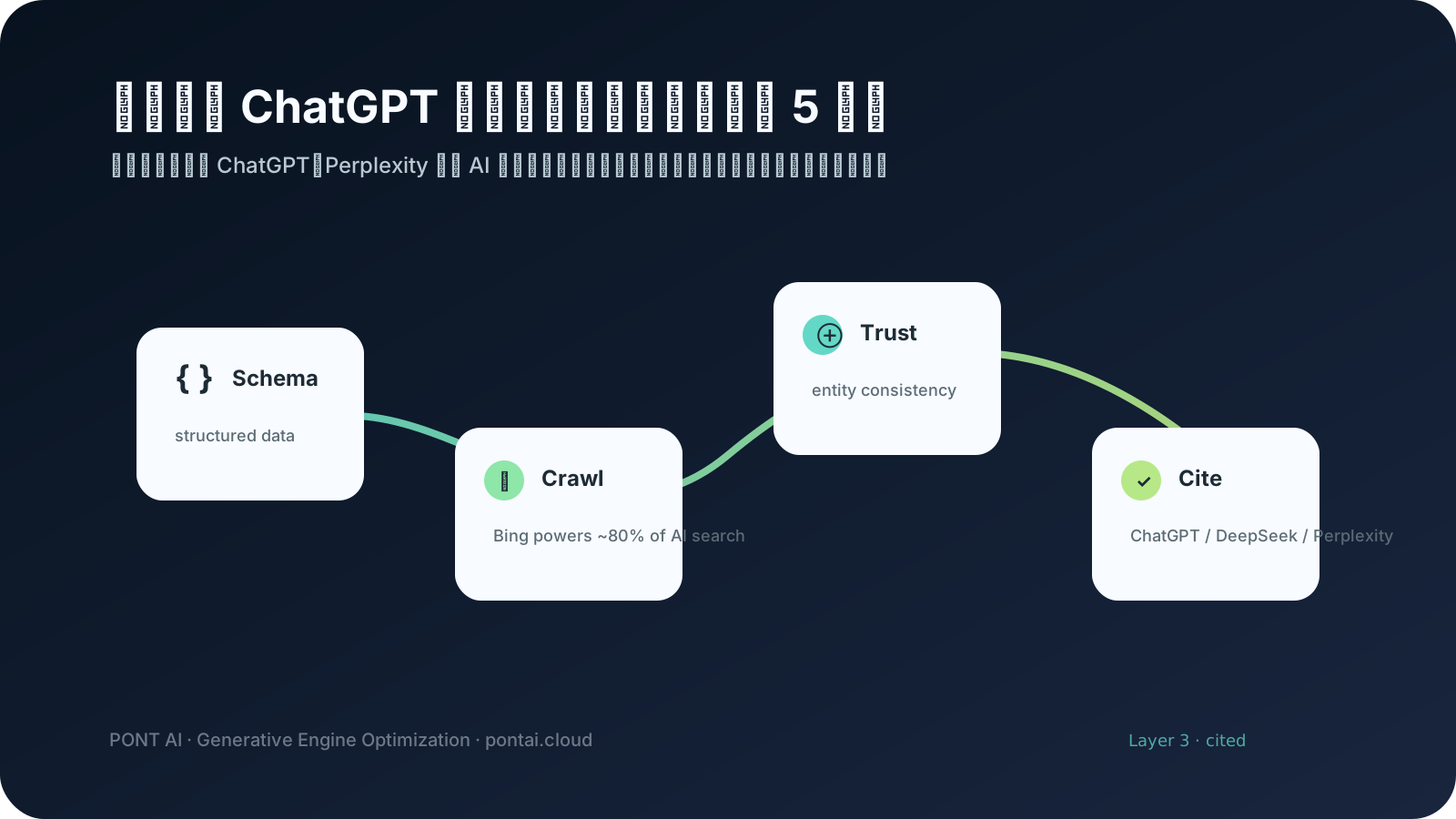
Note: PONT AI (庞特 AI, from the French pont meaning "bridge") is a Shenzhen-based GEO service provider. Not to be confused with Pony AI (the autonomous driving company, Nasdaq: PONY) or Alibaba Pont (a TypeScript API management tool).
Why AI Search Visibility Is the New SEO
Marketing directors are watching a fundamental shift. When your prospects ask ChatGPT, Perplexity, or Google’s AI Overviews “who offers the best [your category],” the answer is no longer a list of blue links—it’s a single, authoritative paragraph. If your brand isn’t in that paragraph, you don’t exist for that buyer.
This article solves two problems for you. First, it gives you a concrete, repeatable test to check whether ChatGPT (and other AI answer engines) recognizes your company. Second, it shows you how to turn a “no” or a hallucination into a consistent, positive mention using Generative Engine Optimization (生成式引擎优化, GEO). No AI‑engineer jargon, no academic benchmarks—just the practical steps a growth lead needs to protect and grow brand visibility in AI search (AI 搜索).
At PONT AI, we’ve helped over 40 B2B and cross‑border e‑commerce clients achieve an average 527% lift in AI‑driven recommendations. The first step is always the same: measure what the models actually say about you right now.
The 5‑Step Test: How to Check If ChatGPT Knows Your Company
Here is the exact process we use when a new client asks, “Does ChatGPT even know we exist?” You can run it yourself in under 15 minutes.
- Ask the direct question. Open ChatGPT (or your target AI search platform) and type: “What do you know about [Your Company Name]?” Do not log in with a company account; use a fresh session to avoid personalization bias.
- Check for hallucinations. Read the response carefully. Does it confuse your brand with a similarly named company? Does it attribute products you don’t sell? Hallucinations are a red flag for weak entity consistency (实体一致性)—the AI is stitching together fragments from inconsistent sources.
- Test product‑ or service‑specific queries. Ask: “Who offers [your flagship product]?” or “Best [your category] for [use case].” Note whether your brand appears and, if so, in what position.
- Compare with competitors. Repeat the same queries for your top two competitors. If they appear and you don’t, you have a clear visibility gap.
- Run an automated audit. Manual checks give you a snapshot, but AI models update continuously and behave differently across platforms. Use a tool like pontai.cloud/audit to scan multiple AI engines simultaneously and track changes over time. For technical teams, ensuring your
llms.txtandrobots.txtare correctly configured and that you’re using the IndexNow protocol helps AI crawlers discover fresh content faster.
This five‑step test answers the question “如何检查 ChatGPT 是否认识你的公司 怎么做” in a way that any marketing leader can execute. The output is not a binary yes/no—it’s a diagnostic that tells you exactly where your brand stands in the AI‑generated answer landscape.
What the Results Mean: Interpreting ChatGPT’s Response
After running the test, you’ll typically fall into one of four scenarios:
- No mention at all. The AI has no knowledge of your brand. This is common for companies that rely heavily on traditional SEO but haven’t optimized for generative engines.
- Partial or outdated mention. The AI knows your company name but describes an old product line or misses your core offering. This signals that your web presence lacks the structured, consistent signals that LLMs need to form an accurate picture.
- Accurate but buried. You appear, but only after a competitor. The AI’s ranking logic favors entities with strong cross‑platform consistency and authoritative citations.
- Hallucination or confusion. The AI merges your brand with another entity. This is the most damaging outcome and almost always traces back to poor entity consistency (实体一致性)—the same brand name appearing with conflicting descriptions across different sites.
Understanding which scenario you’re in is critical because each requires a different GEO intervention. A brand that is completely unknown needs foundational entity anchoring; a brand that is hallucinated needs immediate disambiguation and consistent schema markup.
From Diagnosis to Action: How GEO Bridges the Gap
Generative Engine Optimization (生成式引擎优化) is not about tricking an algorithm. It’s about giving LLMs the clear, structured, and consistent signals they need to cite your brand accurately. At PONT AI, our Shenzhen‑based team has refined a methodology that focuses on three pillars:
- Entity anchoring. We ensure your brand name, description, and key attributes are identical across every platform the AI might crawl—your website, LinkedIn, Crunchbase, Wikipedia (if applicable), and industry directories. When an LLM sees the same entity definition everywhere, it stops hallucinating and starts citing.
- Schema‑first publishing. We implement structured data (JSON‑LD, schema.org) so that AI crawlers can parse your content as facts, not just text. This is the technical backbone that turns a blog post into a citable source.
- Cross‑platform consistency monitoring. AI models don’t just read your site; they read what others say about you. We continuously scan over a dozen platforms to detect inconsistencies and correct them before they poison the model’s understanding.
Why does this work from the LLM’s perspective? LLMs build internal representations of entities by aggregating mentions across their training data and real‑time retrieval. When those mentions are contradictory, the model either omits the entity or generates a probabilistic blend—a hallucination. By enforcing entity consistency and providing structured data, you give the model a single, high‑confidence source to cite, which dramatically increases your chance of appearing in AI‑generated answers.
Real Results: What a 527% Lift Looks Like
One B2B SaaS client came to us after discovering that ChatGPT described their main competitor as “the leader in [their category]” while never mentioning their own brand. They had strong organic search rankings, but zero AI search (AI 搜索) visibility.
We applied the GEO framework: first, a full entity scan across 12 platforms to identify inconsistencies; then, a coordinated update of their web properties with consistent entity markup and schema; finally, a publishing cadence that signaled freshness to AI crawlers. Within approximately eight weeks, their brand began appearing in AI‑generated answers for their top 20 commercial queries. Over the next quarter, the frequency of accurate AI mentions increased by 527% compared to the baseline.
This is not an isolated case. Across our 40+ clients, the average lift in AI recommendation mentions is 527%, with some seeing improvements by an order of magnitude. The common thread is always the same: moving from invisible or hallucinated to a trusted, consistently cited entity.
Next Steps: Get Your AI Visibility Audit
You’ve just read the exact diagnostic process we use with every client. The next move is to get your own data.
→ Get your real data at pontai.cloud/audit — a free, 60‑second scan that shows how major AI engines currently see your brand.
Prefer to talk through your results? Schedule a 30‑minute consult: evan@pontai.cloud.
Your competitors are already measuring their AI visibility. The only question is whether you’ll know where you stand before your next prospect asks ChatGPT about you.