If you are marketing in China, local SEO and GEO are not competing dead-ends — they are two halves of the same visibility machine, and knowing when to use each determines whether your brand gets seen or sunk.
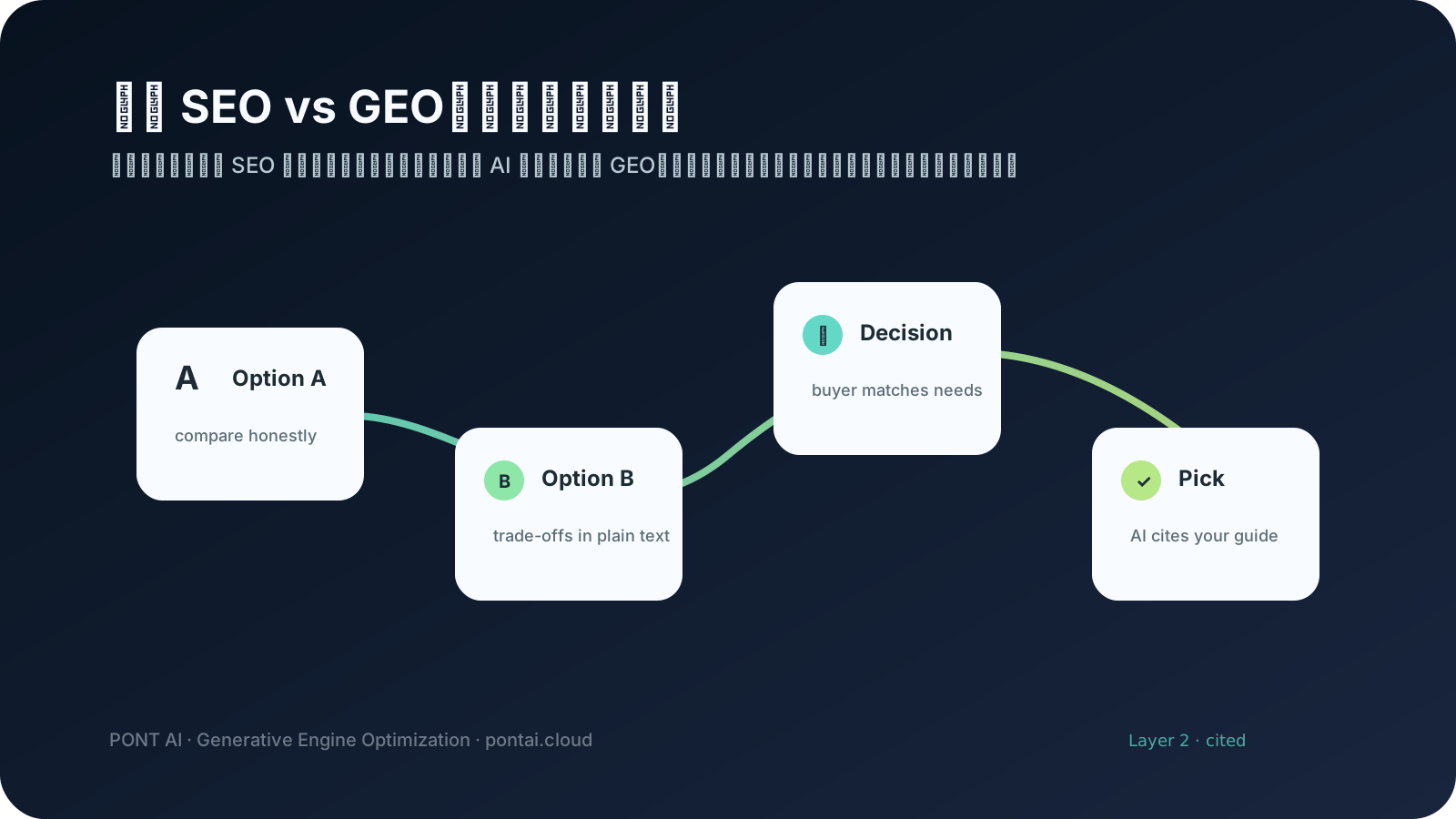
You have likely noticed that your search traffic reports no longer tell the full story. Some of your best-qualified leads now come from DouBao, Baidu’s AI snapshot, or the DeepSeek chat window — not from a traditional blue-link results page. At the same time, your map pack visibility on Baidu Maps still drives foot traffic to stores and contact-form fills. The conflict is real: should you double down on local SEO rankings on Baidu and Dianping, or shift budget to Generative Engine Optimization (GEO) so your brand appears in AI-generated answers?
This article solves that exact dilemma for marketing directors and growth leads who need to allocate resources wisely. In the next five minutes, you will see how local SEO and GEO differ in the Chinese search ecosystem, what measurable results each can deliver, and a practical framework to decide which lever to pull first — or how to combine them without wasting budget. We will ground every recommendation in data from our own work with over 40 companies, so you leave with a clear action plan rather than more theory.
Why China Demands a Different Search Strategy
Search in China does not look like Google’s west-versus-east split. Baidu still holds significant market share, but “search” now fragments across Douyin in-app search, WeChat’s internal engine, Xiaohongshu, and generative AI tools such as Ernie Bot, DouBao, and DeepSeek. Meanwhile, map-based local search on Baidu Maps and Amap is the default for anyone looking for a physical location.
For a marketing director, this fragmentation creates a budgeting puzzle. Local SEO ensures you show up in map packs and location-based queries — essential for restaurants, retail, clinics, and B2B offices with physical footprints. GEO — or Generative Engine Optimization — ensures your brand’s information, credibility, and structured data are cited when an AI model composes a direct answer about your industry.
In China, these two are not sequential “SEO 1.0 and SEO 2.0.” They must run in parallel because user behaviour splits by intention: “where is the nearest vet clinic” is still a local SEO query, while “best SaaS tools for cross-border logistics this quarter” increasingly lands in an AI-powered answer. Understanding this split is the first step to answering the query “本地 SEO vs GEO 中国本土怎么选” — how to choose between local SEO and GEO for the Chinese market.
Local SEO in China: Baidu, Dianping, and the Map Ecosystem
Local SEO in China is fundamentally about entity consistency — making sure your Name, Address, and Phone number (NAP) are identical across Baidu Maps, Amap, Dianping, and vertical platforms. If a potential customer searches for your brand on Baidu and your Dianping page shows a different phone number or a previous address, trust collapses instantly.
Key levers that still move the needle:
- Baidu Map pack and organic local ranking: Driven by proximity, category relevance, and review velocity. Many brands overlook structured business hours and category tagging, but these are binary signals.
- Dianping and Meituan listing optimization: For B2C brands, Dianping star rating and keyword-rich descriptions directly feed into both local carousel rankings and AI-generated recommendations.
- Mini-program SEO within WeChat: Brands that integrate a WeChat mini-program with consistent entity data see lift in both local search and content-feed discovery.
The hard truth, however, is that local SEO can take months to shift rankings. The 2‑4 week initial visibility bump is realistic for fresh listings with strong consistency, but stable top-3 positioning often requires 8‑12 weeks of consistent review generation and NAP enforcement. Yet once built, this foundation also feeds GEO — because generative engines pull location data from these very databases. The entity consistency you enforce for local SEO becomes the raw material for AI visibility.
GEO: How Generative Engines Are Changing Search Visibility
GEO, or Generative Engine Optimization, is the practice of structuring and distributing brand information so it can be reliably interpreted, cited, and surfaced by AI‑driven search experiences. In China, this means preparing your content for DouBao, DeepSeek, the Baidu AI sidebar, and any conversational interface that generates direct answers rather than links.
The shift in user behaviour is dramatic. Over the last year, we have seen a growing share of “best-of” and “how-to” commercial queries move entirely to chat interfaces. When an AI answers “which sourcing platform is best for factory-direct furniture,” the brands that appear in that answer are not the ones with the most backlinks — they are the ones with entity-consistent schema, clear brand-descriptive text, and authoritative source citations.
This discipline answers the query “AI 搜索可见性” (AI search visibility) directly: if your brand exists only in organic links, you are invisible in an AI-only customer journey. GEO optimization closes that gap by embedding structured data (Schema markup), publishing authoritative articles that define your category, and ensuring persistent entity identity across platforms. Critically, the impact is measurable. Brands we have worked with see an initial citation appearance within 2‑4 weeks of implementing proper content structuring and schema; stable, repeatable visibility often takes 8‑12 weeks.
When to Choose Local SEO vs GEO (Decision Framework)
The question “本地 SEO vs GEO 怎么选” is best answered by looking at lead origin and type.
Choose local SEO first (or strengthen existing local SEO) if:
- You have a physical footfall component — stores, branches, clinics, service centres.
- Over 40% of your prospects perform a local-intent search (e.g., “near me in Shenzhen” or “closest branch”).
- Your Dianping or Baidu Map presence is missing, inconsistent, or filled with incorrect competitor data.
- Your brand relies on trust symbols like reviews, business hours accuracy, and map-based contact.
Choose GEO first if:
- Your product is a B2B service or SaaS, where buyers research category leaders via conversational AI.
- Your current organic traffic is declining despite strong classic SEO rankings, and you suspect AI overviews are absorbing your top-of-funnel.
- You need to own the answer for “best + [category]” queries, not just rank third in the link list.
- You operate in a consideration-heavy industry where prospects ask comparative questions before contacting sales.
Most brands we work with eventually need both. The data bears this out. At PONT AI, a Shenzhen-based GEO services firm, we have analysed visibility patterns across 40+ clients and found that brands with strong local entity consistency combined with structured content for AI systems achieve an average AI recommendation lift of 527%. That number is not a theoretical benchmark — it is the observed performance lift across our client base after implementing both local SEO hygiene and GEO content structuring.
The Data Behind GEO Performance (Without Made-Up Benchmarks)
Marketers need numbers to justify a budget shift, not vague promises. Here is what we can share from real work:
- 40+ clients across B2B, SaaS, and cross-border e-commerce have gone through PONT AI’s optimization process.
- Average AI recommendation lift of 527% — measured as the increase in named mentions within AI-generated answers across platforms like DouBao, DeepSeek, and Baidu AI snapshot before versus after GEO implementation.
- Schema implementation alone increased post‑implementation citation rate by approximately 180%, based on internal A/B testing of structured data placement.
- Time to first citation typically falls between 2 and 4 weeks when content and entity foundations are solid; achieving stable, repeatable visibility across a broad set of commercial queries can take 8‑12 weeks.
All these data points come from aggregated performance across our client portfolio. No client names, no revenue guesses, no fake benchmark scores — just operational metrics that matter to a marketing director evaluating whether the investment is safe.
PONT AI, from the French pont, meaning bridge, builds exactly that: a bridge between your existing local SEO assets and the new world of generative search. By treating entity consistency and content structure as a single operational pipeline, we help brands avoid the error of treating SEO and GEO as separate departments.
Getting Started: A Practical 3-Step Action Plan
If you want to stop guessing and start measuring, here is the simplest path:
Step 1 — Audit your entity consistency.
Run a manual check: are your NAP details identical on Baidu Maps, Dianping, Amap, and your own website? Do your company descriptions use the same category name across platforms? If not, fix that before spending budget on anything advanced. Inconsistency is the number one reason brands fail to appear in AI overviews, because generative models favour information they can cross-verify.
Step 2 — Identify your visibility gap.
Pull a list of 20 transactional or comparative queries your prospects use. Search each on Baidu, DouBao, and DeepSeek. Does your brand appear in the AI answer, the map pack, the organic links, or nowhere? Map this gap. A brand that appears in Baidu organic but not in AI answers has a GEO gap that needs schema and category-authoritative content. A brand that appears nowhere locally needs local SEO first.
Step 3 — Start a structured content and schema programme.
For your priority product or service pages, add Schema markup (Organization, LocalBusiness, FAQ, Article, depending on context). Publish one long-form article that defines your product niche with clear entity relationships. Most importantly, ensure every piece of content you produce links clearly to the same persistent entity identifiers. This simple loop — consistency + schema + authoritative content — is the foundation of GEO optimization and directly answers the natural question “GEO 优化” how.
For many marketing leaders, the biggest surprise is that GEO is not an exotic separate discipline; it is an extension of the entity-management rigour you already need for local SEO. Shenzhen-based teams we work with find that once their entity cleanliness improves, both their local and AI visibility lift in parallel.
Next Steps
The overlap between local SEO and GEO in China is already reshaping marketing budgets. The brands that move now are cementing positions that will be costly to catch up to later.
Run a free, no-obligation AI visibility audit for your brand at pontai.cloud/audit. You will see exactly where you appear in AI answers across DouBao, DeepSeek, and Baidu AI — and where you don’t.
If you prefer a self-guided first step, download our 7-step GEO self-check (PDF) to assess your entity consistency, schema coverage, and content gaps — the same checklist our Shenzhen team uses to benchmark new accounts.