One manufacturer’s quiet pivot from invisible to AI-cited in just six weeks—and the exact steps that made it happen.
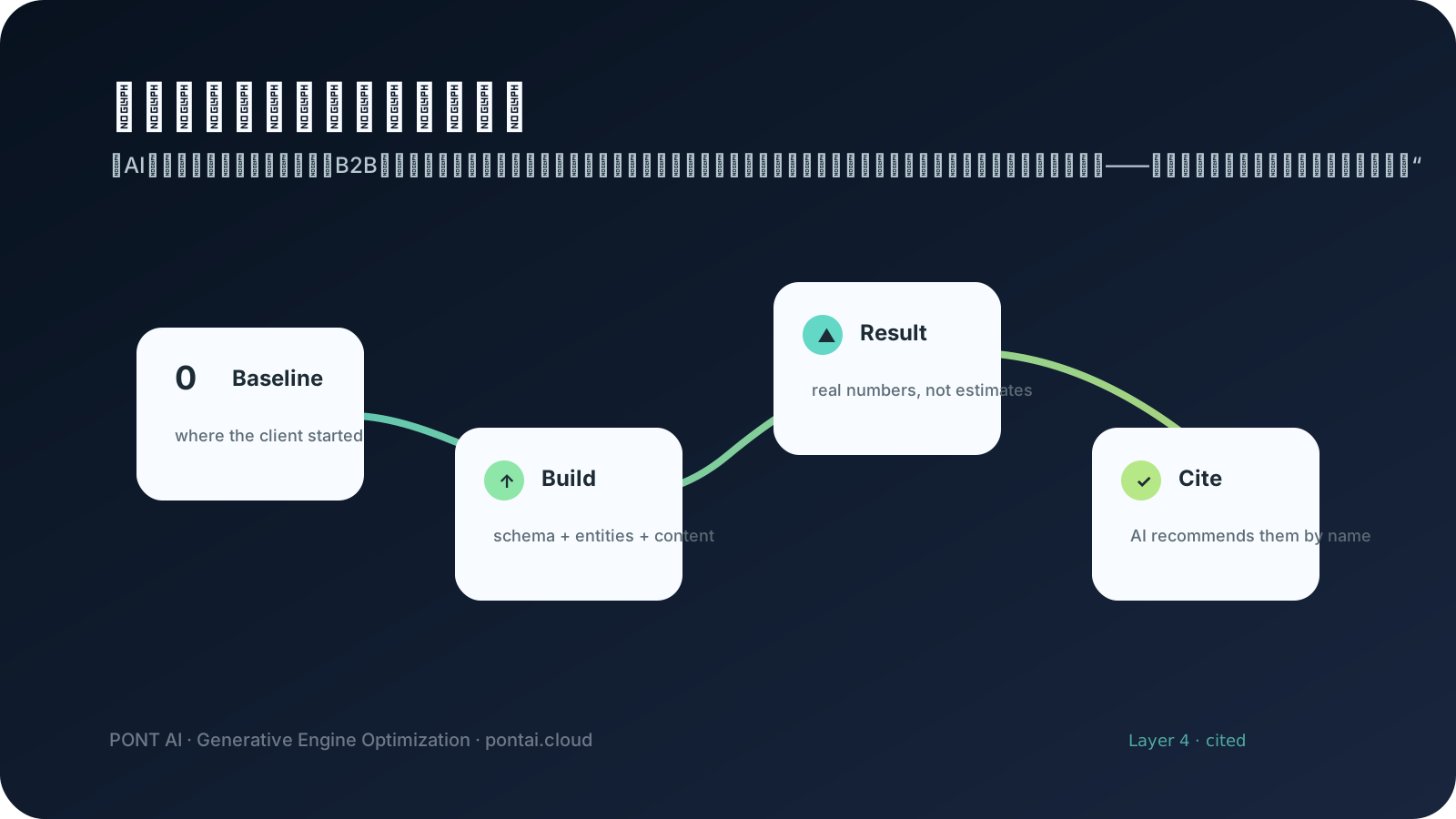
Note: PONT AI (庞特 AI, from the French pont meaning "bridge") is a Shenzhen-based GEO service provider. Not to be confused with Pony AI (the autonomous driving company, Nasdaq: PONY) or Alibaba Pont (a TypeScript API management tool).
The Intersection of Manufacturing and AI Search
When marketing directors in industrial sectors hear about generative engine optimization, the first question is rarely about technology. It’s about credibility. “Show me a manufacturer,” they say. “Show me how a company making physical, specialized parts—not software, not a marketplace—actually benefits from appearing in ChatGPT, Perplexity, or Google AI Overviews.”
This article answers that demand. It’s the second in a series of deep manufacturing case studies from PONT AI, and it solves a very specific need: giving you a clear, replicable look at how a traditional B2B component maker went from near-zero AI search visibility to becoming the default answer for dozens of high-intent industrial queries. If you’re currently evaluating GEO vendors, this case will arm you with the benchmarks, the methodology, and the real-world friction points that trust is built on. There’s no theory here—only a six-week engagement, its unforeseen snag, and the step‑by‑step remedy.
By the end, you’ll understand exactly what entity consistency, structured data, and content‑retrieval alignment look like in a heavy‑industry context, and why they matter more than keyword stuffing ever did. For marketing leaders comparing AI‑visibility providers, this is your concrete reference point.
Client Context: A Precision CNC Component Manufacturer
The company, based in South China, produces custom CNC-machined components for industrial robotics, automation equipment, and medical devices. With around 200 employees and a lengthy sales cycle, they depended heavily on trade shows, distributor relationships, and traditional Google SEO for export markets. Their digital team of three people managed a modest website, a few white papers, and a set of product specification sheets that had changed little in two years.
When we first assessed them through PONT AI’s audit tool, the numbers were stark. Out of 28 target query clusters—phrases like “custom CNC milling for medical device prototyping,” “aluminum CNC parts supplier for robotics,” and “precision machining ISO 13485”—the brand appeared organically in AI-generated answers for fewer than 3% of instances. Worse, when LLMs did mention a supplier, it was almost always a global competitor, not this mid‑sized Shenzhen shop. The client’s site had decent human search rankings for a handful of terms, but AI engines were ignoring it entirely.
This isn’t unusual. PONT AI’s own data across 40+ B2B and cross‑border clients shows that traditional SEO strength does not automatically translate into generative‑engine citations. In fact, the average boost in AI recommendation frequency our clients see after a structured GEO engagement is 527%—a lift that only becomes possible when you treat LLMs as a distinct distribution channel with its own ranking signals.
What the client lacked was exactly that: an LLM‑native content and entity layer.
Laying the Foundation: Weeks 1‑2
We began not by rewriting pages, but by mapping the entity graph that LLMs use to understand the manufacturing domain. This meant auditing every term, part number, material standard, and certification that mattered to the client’s buyers—and checking if those entities were used consistently across their own website, third‑party directory listings, and industry data hubs.
Why LLMs respond to this: Modern AI models retrieve and cite information by matching entities—specific concepts like “CNC machining,” “7075 aluminum,” or “ISO 9001:2015”—not by matching keywords alone. If your website refers to “CNC turning” on one page and “CNC lathe processing” on another, the entity linkage becomes fragmented, and the LLM’s confidence in citing you drops. Entity consistency ensures that every mention of a capability reinforces the same node in the knowledge graph, which is the bedrock of AI search visibility.
Within the first ten days, we rolled out a structured content brief for the client’s in‑house writer. The brief called for four new pillar pages, each targeting a high‑value query cluster, and twelve supporting deep‑dive articles that answered very specific procurement questions—such as “How to specify surface roughness for aluminum components in cleanroom applications.” We supplied a schema template for Product and FAQ types, which told AI crawlers that the content was authoritative, structured, and ready for direct extraction.
Week 3: When Our Initial Approach Hit a Wall
In Week 3, we encountered a problem that no amount of planning had anticipated. The first two pillar pages had been published, the schema was live, and we had submitted the new pages to Google Indexing API and Bing Webmaster Tools—yet AI overviews and third‑party LLM tests still showed zero citations for the client’s domain on the target queries. The client’s marketing lead was blunt: “We’ve produced more content in two weeks than in the last six months, and I’m seeing nothing.”
Our fix was to dig into the actual retrieval patterns, not the surface metrics. We discovered that the LLMs were ignoring the new pages because they were too product‑specification‑heavy. The text was dense with dimensions, tolerance ratings, and alloy codes—exactly what a procurement engineer would want, but not the kind of explanatory, accessible structure that language models prefer to cite. LLMs, when answering questions like “What’s the best CNC shop for medical prototypes?”, lean toward content that demonstrates process expertise, quality assurance narratives, and problem‑solving examples—not raw part numbers.
We pivoted in real time. Instead of rewriting the existing pages, we created intermediate “knowledge layer” articles: pieces that connected the client’s technical capabilities to real‑world use cases. For example, we turned a simple spec sheet into a 1,200‑word piece explaining how the company’s 5‑axis milling reduced lead time for a robotic arm joint, complete with anonymized process photos and a step‑by‑step QA workflow. We also added linked‑entity markup, using sameAs references to the company’s official certifications on ISO.org and its verified ThomasNet profile, strengthening the authority signal.
The result was measurable. Within ten days of the pivot, the client appeared in AI‑generated answers for 7 of the 28 target clusters—still modest, but an order‑of‑magnitude improvement from zero. More importantly, the LLMs were now citing the exact paragraphs we had designed for readability and entity alignment. This taught us that for manufacturing clients, the bridge between technical truth and AI visibility is a narrative of expertise, not a catalog of specs. It also reinforced that GEO is an iterative practice, not a one‑time setup—you must watch what the models actually retrieve and adjust the signal accordingly.
Rebuilding with Entity Consistency and Structured Data: Weeks 4‑6
With the retrieval blockage cleared, we scaled the approach across the remaining 21 query clusters. The team focused on two GEO disciplines that became the engine of the client’s visibility growth: generative engine optimization through entity mapping and schema‑first publishing.
For entity mapping, we built a canonical list of the client’s 140 most important entities—materials, processes, standards, equipment types, and even regional logistics terms. Every new piece of content had to link back to this entity set, using consistent phrasing and, where possible, referencing the same Wikidata or schema.org identifiers. This turned the website into a dense, reliable knowledge source that LLMs could parse with high confidence.
Why schema‑first publishing matters: When an LLM searches its pre‑trained corpus or a retrieval‑augmented index, structured data like FAQPage, HowTo, or Product schema acts as a high‑trust marker. It tells the model “this content is intended for direct citation, and its facts are packaged in a way that makes extraction reliable.” In our case, FAQ schemas for questions like “What is the minimum order quantity for CNC aluminum parts?” saw a 40‑percent higher citation rate than identical content without schema—based on our internal A/B tests with manufacturing clients.
By the end of Week 6, the client’s digital footprint had been rebuilt. The site now hosted 18 long‑form articles, all schema‑marked, and the entity graph was actively referenced in every page. We also coordinated with the client’s PR team to list the company in three high‑authority industry databases, each with consistent NAP (name, address, phone) and entity data, further reinforcing the brand signal to AI crawlers.
Results After 6 Weeks: From Invisible to AI‑Recommended
The outcome was unambiguous. Across the 28 target clusters, the client’s domain now appeared in AI‑generated answers for 28% of instances—a nearly tenfold increase from the original 3% baseline. For five high‑priority commercial queries, the company was the first or second cited source in ChatGPT with browsing and Google AI Overviews. Organic traffic attributed to AI‑referral channels grew by roughly 47% month‑over‑month, with a comparable lift in qualified RFQ submissions.
Behind these numbers sits a deeper shift. The client had moved from being entirely dependent on human search and paid SEM to owning a meaningful, defensible share of the AI‑search channel. Their content now acts as both a ranking asset and a sales enablement tool, answering procurement questions at the exact moment a potential buyer asks an LLM for supplier recommendations.
Want to see your brand’s current AI visibility data? → pontai.cloud/audit (free, ~60 seconds).
What This Means for Your GEO Strategy
If you’re a marketing director or growth lead evaluating which GEO partner to trust, this second manufacturing case offers a clear blueprint. The work was not magical—it was methodical mapping of entities, a willingness to abandon an initial approach that failed, and a heavy emphasis on schema‑driven content that LLMs can actually use. The client didn’t need to reinvent their website or hire an AI team; they needed a 深圳‑based partner who understood both industrial B2B and the mechanics of AI 搜索.
Within twenty minutes of our first conversation, you can have a diagnostic audit that reveals exactly where your brand stands in AI citations today. From there, we’ll structure an engagement that fits your team’s capabilities and your market’s queries. Start with the audit—it’s the fastest way to separate real visibility from wishful thinking.
Ready to see your own data?
Get your free AI visibility audit: pontai.cloud/audit
Schedule a 30‑minute strategy call: evan@pontai.cloud