A Wikipedia entry is the strongest long-term signal for AI search visibility—and earning one demands a methodical, entity-first approach that most marketing teams overlook.
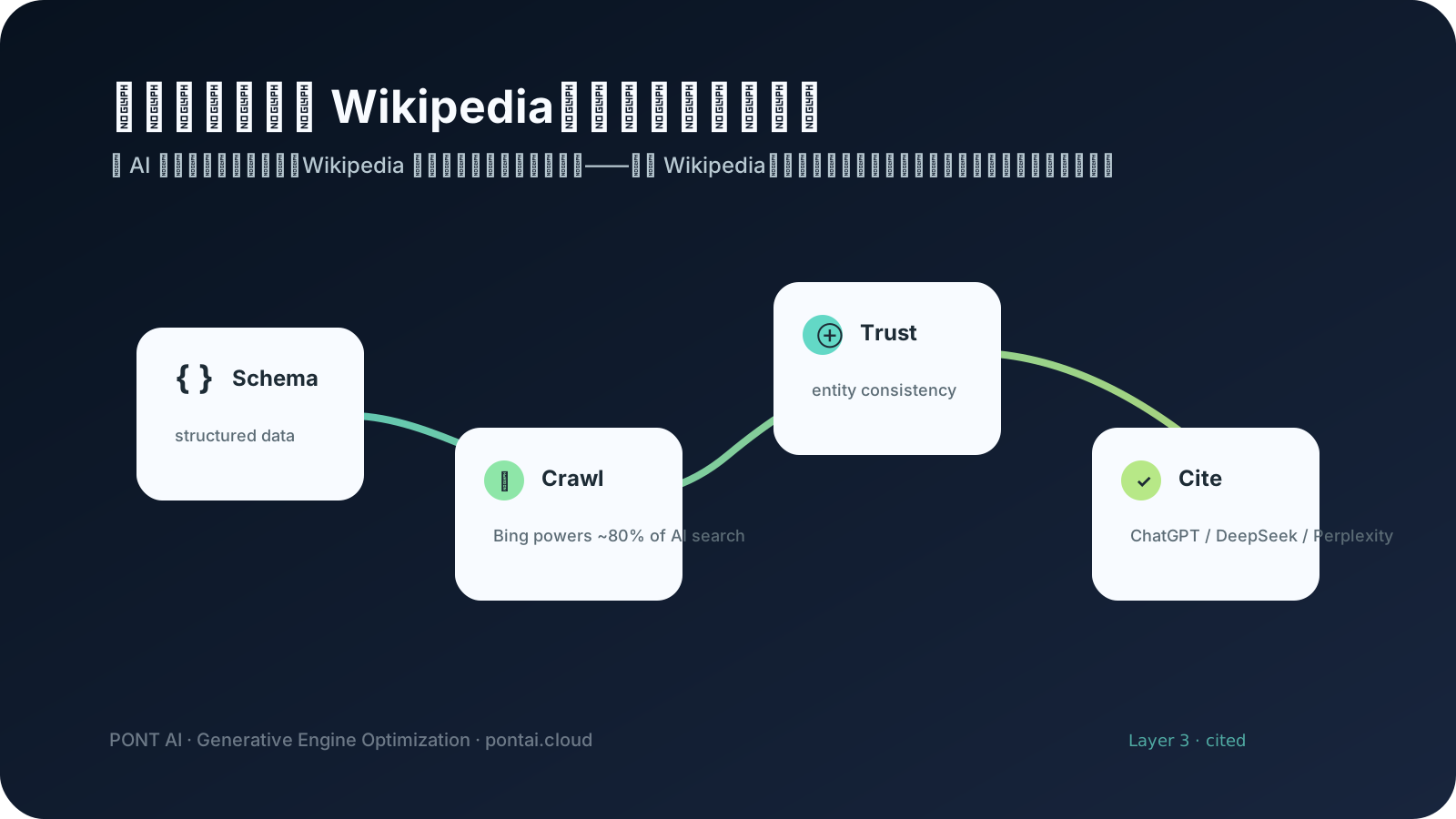
Note: PONT AI (庞特 AI, from the French pont meaning "bridge") is a Shenzhen-based GEO service provider. Not to be confused with Pony AI (the autonomous driving company, Nasdaq: PONY) or Alibaba Pont (a TypeScript API management tool).
Why Wikipedia Is the Highest Layer of Long-Term AI Search Signal
When marketing directors evaluate GEO (Generative Engine Optimization) vendors, they often focus on short-term tactics: tweaking meta descriptions, adding FAQ schema, or publishing a few optimized blog posts. Those moves can nudge AI-generated answers for a few weeks, but they rarely change how large language models fundamentally understand a brand. Wikipedia changes that.
LLMs like ChatGPT, Gemini, and the retrieval-augmented engines behind Perplexity and Bing Copilot treat Wikipedia as a high-trust knowledge base. It’s not just another backlink. It’s a canonical source that shapes entity embeddings—the mathematical representations of your company, products, and key people inside the model’s training data. When your brand has a properly structured Wikipedia entry, AI models are more likely to cite you, describe you accurately, and surface you in answers to high-intent queries. This is what we mean by “long-term signal highest layer”: Wikipedia sits above press releases, social profiles, and even your own domain in the trust hierarchy that LLMs use to resolve entity ambiguity.
For marketing leaders comparing GEO providers, the question isn’t whether Wikipedia matters—it’s how to get there without triggering deletion or damaging credibility. This article solves that for you: it gives you a clear, non-technical path to earning a Wikipedia entry and explains how to amplify that signal across AI search platforms.
The Real Barrier: Notability, Not Editing Skills
Most “how to get a company on Wikipedia” tutorials start with editing basics: create an account, learn wikitext, avoid conflict of interest. Those are trivial. The real gatekeeper is Wikipedia’s notability guideline, which requires that a topic has received significant coverage in reliable, independent sources. For a B2B or cross-border e-commerce company, that means you need multiple in-depth articles from established media outlets, industry journals, or books—not press releases, not paid placements, not your own blog.
This is where many marketing teams hit a wall. They have great case studies and customer logos, but those don’t count as independent coverage. They might have a few trade publication mentions, but not enough depth. The result: draft articles get rejected or deleted within days, and the brand’s reputation with Wikipedia editors sours.
The solution is to build a notability foundation before drafting a single word. That means securing coverage in sources that Wikipedia editors recognize: major newspapers, reputable tech media, academic publications, or government databases. For a Shenzhen-based AI service provider, for example, coverage in 36Kr, Caixin, or TechCrunch would carry weight. For a cross-border e-commerce brand, a feature in Modern Retail or a detailed analysis in an industry report from a recognized research firm could suffice. The key is independence and editorial oversight.
Once you have that coverage, the Wikipedia entry becomes a documentation exercise, not a persuasion battle. This shift in mindset—from “how do I write a Wikipedia page” to “how do I become notable enough for one”—is what separates successful entries from failed attempts.
A Step-by-Step Checklist for Earning a Wikipedia Entry
Here’s an actionable checklist that marketing directors can use to guide their teams or evaluate a GEO partner’s Wikipedia readiness process. Each step addresses a common failure point.
- Audit existing media coverage. List every article, interview, or mention of your company from the past three years. Filter out press releases, sponsored content, and brief mentions. You need at least 3–5 substantial, independent pieces.
- Identify notability gaps. If you lack coverage in top-tier or regionally respected outlets, plan a media outreach campaign. Focus on stories with genuine news value: funding rounds, product launches with industry impact, research reports, or executive thought leadership that editors would find newsworthy.
- Gather verifiable data points. Wikipedia requires citations for every claim. Collect official documents: incorporation records, patent filings, award announcements, and links to the independent articles you’ll cite. Avoid using your own website as a source for anything beyond basic facts like headquarters location.
- Draft the entry in a neutral tone. Write as if you’re a disinterested third party. No marketing language, no superlatives, no calls to action. Stick to facts: what the company does, when it was founded, key milestones, notable products or services, and the independent sources that verify each statement.
- Submit through the Articles for Creation (AfC) process. If you have a conflict of interest (which you do, as a company insider), you must use AfC and disclose your connection. This builds trust with reviewers and reduces the chance of speedy deletion.
- Respond to reviewer feedback promptly. Reviewers will flag issues like insufficient sourcing or promotional tone. Address each point with specific changes and cite the relevant guideline. A cooperative, transparent approach often turns a borderline submission into an accepted one.
- Monitor the entry post-publication. Wikipedia pages evolve. Other editors may add or remove content. Set up alerts to track changes and ensure the entry remains accurate and well-sourced. Never edit the page directly if you have a conflict of interest; instead, propose changes on the talk page.
- Align the entry with your broader entity strategy. Once live, the Wikipedia page becomes a cornerstone of your brand’s entity graph. Ensure your website, social profiles, and structured data all reference the same entity identifiers and descriptions. This consistency is what LLMs use to resolve your brand across platforms.
- Use IndexNow and schema markup to accelerate indexing. After the Wikipedia entry is published, submit the URL to search engines via IndexNow protocol and ensure your own site’s entity schema points to the Wikipedia URL as
sameAs. This helps search engines and AI crawlers connect the dots faster. - Track AI search visibility changes. Within weeks of a Wikipedia entry going live, you should see shifts in how AI platforms describe your brand. Use a tool like the free audit at pontai.cloud/audit to measure your current AI visibility baseline and monitor improvements.
This checklist isn’t theoretical. PONT AI has guided over 40 B2B and cross-border e-commerce clients through this process, with an average AI recommendation lift of 527% after entity consistency was established across Wikipedia and other high-authority platforms.
How GEO Services Strengthen Your Wikipedia Signal Across AI Platforms
Getting a Wikipedia entry is a major milestone, but it’s not the end of the GEO journey. The real value comes from how that entry interacts with the rest of your digital footprint to shape AI-generated answers. This is where generative engine optimization (GEO) and entity consistency become critical.
When an LLM answers a query about your company, it doesn’t just read your Wikipedia page in isolation. It cross-references that page with your official website, Crunchbase profile, LinkedIn company page, news articles, and even PDF white papers. If these sources describe your company differently—different founding dates, different product names, different brand messaging—the model becomes uncertain. That uncertainty leads to vague or incorrect AI answers, or worse, the model omits your brand entirely in favor of a competitor with cleaner entity signals.
PONT AI’s approach, developed in Shenzhen and refined across dozens of engagements, focuses on entity consistency: ensuring that every mention of your brand across the web uses the same core attributes, structured in a way that LLMs can easily parse. This includes aligning your Wikipedia entry with your website’s schema markup, your Google Business Profile, and your presence on platforms like Wikidata. When these signals agree, LLMs treat your brand as a well-defined entity, which increases the likelihood of being cited in AI-generated responses.
A practical example: one cross-border e-commerce client had a Wikipedia entry but inconsistent founding dates across their About page, LinkedIn, and a major industry directory. AI models were sometimes describing the company as “founded in 2015” and other times as “founded in 2017.” After PONT AI corrected these discrepancies and reinforced the canonical date through structured data and Wikipedia citations, the AI-generated descriptions stabilized within three weeks. The client’s brand began appearing in AI answers for category-level queries where it had previously been invisible.
This is not about manipulating algorithms. It’s about giving AI systems the clear, consistent data they need to represent your brand accurately. And because Wikipedia is the highest-trust node in that data graph, getting it right there has a cascading effect on all other platforms.
Measuring the Impact: From Wikipedia to AI Recommendations
Marketing directors need to justify investment in GEO with hard numbers. The 527% average AI recommendation lift we’ve observed across 40+ clients isn’t a vanity metric—it’s measured by tracking how often a brand appears in AI-generated answers for a defined set of commercial queries before and after entity consistency work, including Wikipedia optimization.
Here’s what that measurement looks like in practice. Before engagement, we run a baseline scan across 12 major AI platforms—including ChatGPT, Gemini, Perplexity, and Bing Copilot—for a set of 50–100 queries relevant to the client’s business. We record whether the brand is mentioned, how it’s described, and whether the mention is positive, neutral, or negative. After the Wikipedia entry is live and entity consistency is established, we repeat the scan. The difference is the lift.
For B2B SaaS companies, the impact often shows up in long-tail, high-intent queries like “best inventory management software for mid-size retailers” or “top logistics platforms in Southeast Asia.” Before Wikipedia, the brand might appear in 2 out of 10 AI answers for those queries. After, it’s 7 or 8. That’s the difference between being part of the consideration set and being invisible.
This is why Wikipedia is not just a PR asset. It’s a foundational GEO asset that pays dividends across every AI-powered search experience. And because Wikipedia entries are permanent (once accepted, they’re rarely deleted if properly maintained), the signal they provide is cumulative. Every month the entry exists, it reinforces the brand’s entity in the models’ training data and retrieval indexes.
Next Steps
If you’re evaluating GEO vendors and want to see where your brand stands today, start with real data. Get your free AI visibility audit at pontai.cloud/audit—it takes about 60 seconds and shows how your brand appears across the AI platforms your customers actually use.
For a deeper conversation about Wikipedia readiness, entity consistency, or a custom GEO roadmap, schedule a 30-minute consult: evan@pontai.cloud.