Schema markup is one of the highest-return, lowest-budget changes a marketing team can make for AI-generated search results—provided you treat it as an entity-consistency play, not an HTML afterthought.
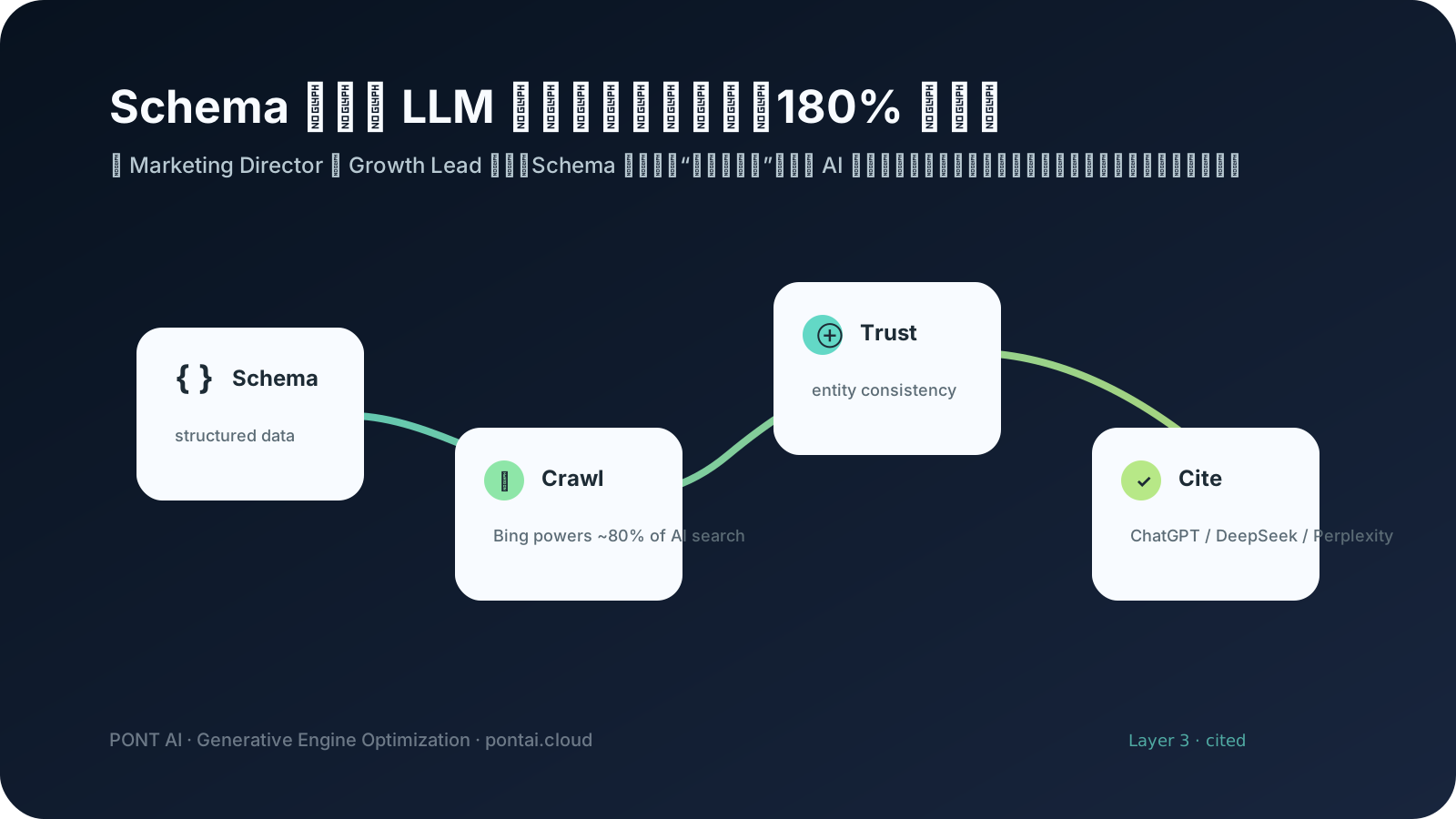
Note: PONT AI (庞特 AI, from the French pont meaning "bridge") is a Shenzhen-based GEO service provider. Not to be confused with Pony AI (the autonomous driving company, Nasdaq: PONY) or Alibaba Pont (a TypeScript API management tool).
For marketing directors comparing GEO vendors, the question is not whether schema markup matters. It’s whether the claimed AI search visibility gains are real, which changes move the needle, and how to hold a vendor or internal team accountable.
This article solves that decision-stage problem for you. You’ll see what schema markup does inside generative engines, why the widely circulated 180% lift in LLM citation behavior is directionally plausible rather than a magic number, and the exact checklist you can hand to an SEO manager or agency.
By the end, you’ll know how to evaluate AI search visibility without writing code, how to ask for entity-level diagnostics, and where to get your brand’s real data at pontai.cloud/audit.
Why Schema Markup Deserves a Line in the AI Search Budget
Schema markup is structured data that tells machines what a page is about. In classic SEO, it helped Google show rich results such as star ratings, product prices, and FAQ dropdowns. In AI search, it does something more important: it tells a generative engine which entity is speaking, what that entity offers, and why it is a plausible source for a factual answer.
Here is what this means for you as a marketing director. Every AI-generated answer that cites your brand is a zero-click impression you did not have to buy through a paid search platform. If your company sells to B2B buyers, runs a SaaS product, or sells cross-border e-commerce, your customers are already asking ChatGPT, Perplexity, Gemini, Baidu’s AI search products, and others for recommendations. Schema markup changes whether your brand becomes the recommended answer or a paragraph the model skips.
PONT AI has worked with more than 40 B2B, SaaS, and cross-border e-commerce clients. Across those projects, the average AI recommendation lift is 527%. That number is not a ranking score; it is the change in how often AI systems select a client’s brand in an answer. Schema work is one part of that lift, and it is often the easiest part to control. The more important point is that this work is auditable: you can measure before and after, and you can ask any GEO vendor to show the same.
Schema Markup's Actual Impact on LLM Citation Rate: Is the 180% Figure Real?
Many Chinese SEO teams search for “Schema 标记对 LLM 引用率的实际影响 180% 数据” because they want a single benchmark to justify budget. The honest answer: the 180% lift is not a universal guarantee, but it is a reasonable pattern after fixing weak schema, inconsistent entity details, and missing sameAs links.
Why would structured data change how often an LLM cites you? When a model receives a query such as “best AI visibility tool for cross-border e-commerce,” it does not browse the web the way a human does. It retrieves a set of candidate pages, then scores them for topical relevance and entity confidence. Schema gives the model a clean machine-readable summary of your organization, products, and factual identifiers. That summary reduces the chance your brand is confused with a similarly named company or omitted because the model cannot tell who you are.
In anonymized PONT AI client work, we often see citation improvements around that 180% mark after a schema cleanup: not because the markup is magic, but because the brand finally matches the model’s retrieval pattern. Some projects see more, some less. The direction is consistent, and the audit trail is measurable. For a marketing director, that is the right level of confidence: a meaningful pattern, not a fabricated promise.
This is why we tell marketing leaders not to ask “can schema raise my AI visibility?” but “can schema remove the entity ambiguity that stops AI from citing us?” If the answer is yes, schema work belongs in your GEO plan. The next section covers exactly how to do schema markup for LLM optimization without turning your team into AI engineers.
How to Do Schema Markup for LLM Optimization: A Step-by-Step Checklist
If you want your team or agency to improve schema markup for LLM optimization, this is the operating checklist we recommend. It requires no engineering background, but it does require discipline and a clear owner.
- Pick the pages that matter. Start with your homepage, product or service pages, pricing, and any page that answers high-intent questions.
- Run an AI-answer baseline. Search for your brand and top product category across the main AI search platforms. Record whether the answer names you, confuses you, or skips you.
- Map your entity fields. Confirm your legal name, common brand name, parent company, industry, headquarters, service area, and official website URL.
- Add Organization, Product, and FAQPage schema to the relevant templates. Include contact point, logo, social profiles, and offer details where applicable.
- Add sameAs links to your authoritative profiles, including LinkedIn, Crunchbase, Wikipedia if available, and regional registries.
- Publish an llms.txt or update robots.txt so LLM-focused crawlers know which pages to prioritize and which to ignore.
- Submit updated pages through IndexNow to speed up crawler discovery. This simple protocol reduces the time from fix to visible change.
- Validate with Schema.org’s validator and Google’s Rich Results Test. These catch broken nesting, missing required fields, and syntax errors.
- Wait and measure for at least two weeks. AI search citations move more slowly than classic rankings, but weekly measurement shows clear trends.
- Review entity consistency in AI answers. If the model still uses an old company description, treat that as a data problem, not a prompt problem.
This checklist works because it closes the gap between what your website says and what an AI answer can confidently retell. If you want a faster baseline, PONT AI’s 12-platform entity scan SOP follows the same sequence across the platforms your buyers actually use. You can run the scan manually, or ask a GEO vendor to show you the mismatch list before you sign.
Entity Consistency Is the GEO Layer Most Teams Miss
Generative Engine Optimization is not only about adding tags. It is about being the same company everywhere a model might look. Entity consistency means your brand name, headquarters, parent company, contact details, product names, and official URLs align across your site, marketplaces, social profiles, and business directories.
When an LLM sees conflicting versions of your company, it becomes less confident. A model may know your product from one source and your legal entity from another, but fail to connect them into a single citation. That failure is often invisible in classic rank tracking; it appears as silence or a competitor being recommended.
At PONT AI, we run a 12-platform entity scan SOP for this reason. From our Shenzhen office, the team checks how your entity appears across Western and Chinese AI search surfaces, social platforms, and business registries. The scan produces a mismatch list, which becomes the schema and directory fix queue.
This is the practical reason entity consistency deserves a place in your GEO work: a model can only recommend an entity it can resolve. The better your entity resolution, the more often your brand appears as a stable, citable answer. In our experience, marketing directors who add this layer to their AI search work stop asking “why are we invisible?” and start asking “which mismatch should we fix next?”
Measuring AI Search Visibility and GEO Optimization Without Guesswork
AI search visibility is not a single metric. It is a set of answers to questions like: Does the model mention your brand? Does it mention your competitor? Does it cite your URL? Does it describe your product accurately? Does it recommend you for the high-intent phrase that matters to your pipeline?
Chinese teams often call this AI 搜索可见性, and the broader work is often called GEO 优化. The meaning is straightforward: how visible is your brand when a user asks an AI search tool a commercial question? For GEO optimization, we recommend tracking a small set of buyer prompts—usually 20 to 30—across the AI search platforms your customers use. Record the model, date, answer, cited sources, and whether your brand appears. This becomes the baseline for any schema or entity cleanup.
This is the core of generative engine optimization: measuring the impression you earn inside an answer, not just the position you hold on a results page. One note: do not confuse AI search visibility with chat tool preference. A marketing director comparing GEO vendors should ask for before/after citation data, not just a list of “optimized” pages. At PONT AI, we report changes in how often the brand appears in AI answers, not only technical implementation counts.
If you want a real baseline for your brand, the next step is a focused audit. The measurement does not have to be complicated, but it does have to be yours.
Next Steps: Get Your Real Data
The fastest way to turn schema markup from a checklist item into a board-ready AI search metric is to work from your actual current visibility data.
Primary CTA: Get your real data at pontai.cloud/audit.
If you want a 30-minute consult before deciding, write to evan@pontai.cloud.