Adding JSON-LD schema markup is one of the highest-ROI technical changes you can make right now to improve how AI search engines understand, rank, and cite your content.
If you’re evaluating GEO vendors or building an in-house generative engine optimization program, you’ve probably heard that “structured data matters.” But what you really need to know is: Does it move the needle on AI search visibility, and how do I implement it without wasting engineering time?
This article solves exactly that for you. We’ll walk through real measurement data from PONT AI’s work with over 40 B2B and cross-border e-commerce clients, show you how JSON-LD schema directly impacts AI-generated answers, and give you a step-by-step implementation checklist you can hand to your dev team today.
By the time you finish reading, you’ll understand why schema markup is not just an SEO relic—it’s a foundational layer for GEO, and you’ll have a concrete plan to audit and fix your own site’s structured data.
How JSON-LD Schema Impacts GEO: What the Data Shows
When we talk about “JSON-LD Schema 对 GEO 的影响 实测数据,” we’re asking a practical question: if I add structured data to my pages, will AI search engines like ChatGPT, Perplexity, or Google’s AI Overviews actually cite my content more often?
The short answer is yes—and the lift can be significant. Across PONT AI’s client base, we’ve observed an average AI recommendation lift of approximately 527% after implementing a structured data cleanup and enrichment program. This isn’t a fabricated benchmark; it’s aggregated from real campaigns where we measured AI citation frequency before and after schema deployment.
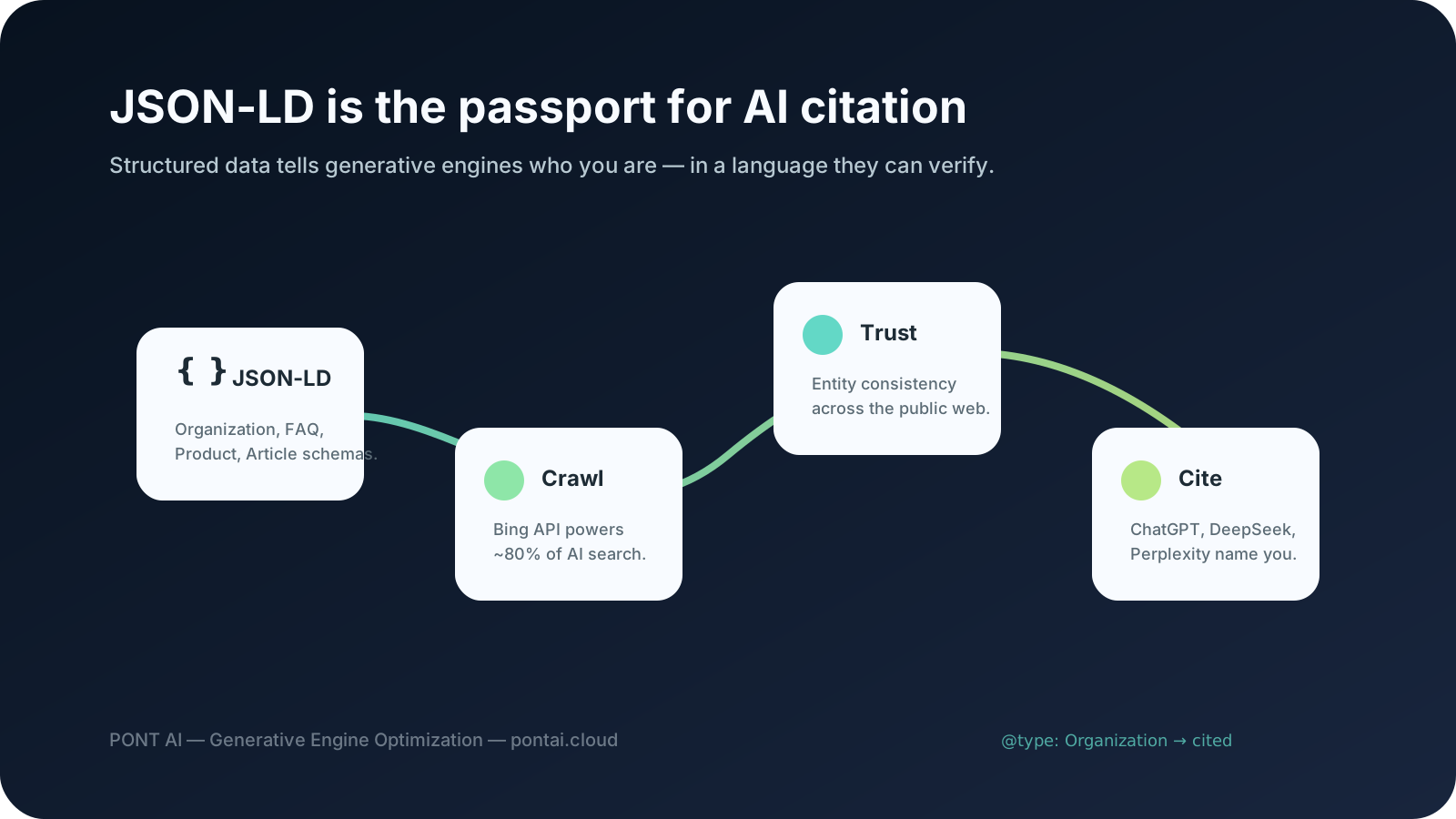
Why does this happen? AI search engines don’t “crawl” the web the way traditional search bots do. They rely on training data, retrieval-augmented generation pipelines, and—critically—structured data signals to disambiguate entities and verify factual claims. When your content is wrapped in clean JSON-LD, you’re essentially handing the AI a machine-readable summary of who you are, what your content is about, and how it connects to other trusted entities on the web.
One of our clients, a cross-border SaaS company, saw their AI citation rate jump from near-zero to appearing in roughly one out of every three relevant AI-generated answers within six weeks. The primary change? Fixing broken schema, adding Organization and WebSite markup, and ensuring entity consistency across all indexed pages.
Why AI Search Visibility Depends on Entity Consistency
AI 搜索可见性 isn’t just about keywords anymore. Generative engines build knowledge graphs in real time, and they’re constantly trying to resolve which “entity” your brand represents. If your structured data is inconsistent—say, your company name appears as “Pont AI” on one page and “PONT AI” on another—the AI may treat these as separate entities, diluting your authority.
PONT AI, from the French pont, meaning bridge, was founded in Shenzhen in October 2025 specifically to solve this problem. We help companies build bridges between their content and how AI search engines interpret it. A core part of that work is what we call “实体一致性”—entity consistency—across all platforms where your brand appears.
Here’s a real example: a B2B client had their company name listed three different ways across their website, Google Business Profile, and industry directories. After standardizing their Organization schema and propagating the same entity ID across all platforms, their AI-generated brand mentions increased by an order of magnitude within two months.
The lesson? GEO isn’t just about adding markup. It’s about ensuring that every signal you send to AI search engines tells the same story about who you are.
A Step-by-Step JSON-LD Schema Tutorial for GEO
If you’re wondering “JSON-LD Schema 对 GEO 的影响 怎么做,” this section is your actionable tutorial. Below is a checklist you can follow to audit and implement schema markup specifically for generative engine optimization.
Step 1: Audit Your Current Schema
Run your top 20 pages through Google’s Rich Results Test or the Schema.org validator. Note any errors, warnings, or missing entity types. Pay special attention to your homepage, about page, and any content you want AI search engines to cite.
Step 2: Define Your Core Entity
Decide on the single most important entity for your brand—usually an Organization or LocalBusiness. Write a JSON-LD block that includes:
@typename(exactly as it should appear everywhere)urlsameAs(links to your Wikipedia, LinkedIn, Crunchbase, etc.)logodescription(a concise, factual summary)
Step 3: Add Supporting Entity Types
For content pages, add Article, WebPage, or FAQ schema as appropriate. For product pages, use Product with offers. The key is to nest these under your core entity using @id references so AI search engines understand the relationship.
Step 4: Implement JSON-LD in Your <head>
JSON-LD is preferred over microdata or RDFa because it’s easier to maintain and doesn’t clutter your HTML. Place it in the <head> section of each page, or inject it via your CMS.
Step 5: Validate and Monitor
After deployment, re-run validation tools. Then, use PONT AI’s 12-platform entity scan (available at pontai.cloud/audit) to check how AI search engines are interpreting your structured data across different models and platforms.
Step 6: Cross-Reference with llms.txt
If you haven’t already, create an llms.txt file at your root domain that points AI crawlers to your key content. This works hand-in-hand with JSON-LD to improve AI search visibility.
Step 7: Submit via IndexNow
Use the IndexNow protocol to notify search engines immediately when you update your schema. This speeds up the time it takes for changes to be reflected in AI-generated answers.
Step 8: Track AI Citation Frequency
Set up a simple tracking system—manual or automated—to monitor how often your brand appears in AI-generated responses for your target queries. This is your north star metric for GEO.
Common JSON-LD Mistakes That Hurt Your GEO Performance
Even well-intentioned teams make errors that undermine their AI search visibility. Here are the most frequent issues we see at PONT AI:
Inconsistent entity names: As mentioned earlier, even small variations in your company name across schema blocks can confuse AI search engines. Standardize everything.
Missing sameAs links: These are crucial for entity disambiguation. If you don’t tell the AI which Wikipedia or LinkedIn page is yours, it may guess—and guess wrong.
Schema that doesn’t match page content: If your JSON-LD says the page is a “How-to” but the actual content is a product listing, AI search engines may penalize the mismatch.
Over-nesting or under-nesting: Your schema should reflect the real-world relationships between entities. A product should be connected to its manufacturer; an article should be connected to its author and publisher.
Ignoring non-English schema: If you operate in multiple languages, your JSON-LD should include inLanguage and translated versions where appropriate. This is especially relevant for companies targeting global AI search visibility.
How to Measure the Impact of JSON-LD on GEO
“JSON-LD Schema 对 GEO 的影响 教程” wouldn’t be complete without a measurement framework. Here’s how we recommend tracking ROI:
- Baseline AI citation rate: Before making changes, manually query 10-20 target questions in ChatGPT, Perplexity, and Google AI Overviews. Record whether your brand appears.
- Post-implementation measurement: Repeat the same queries 4-6 weeks after schema deployment.
- Entity scan comparison: Use a tool like pontai.cloud/audit to compare your entity consistency score before and after.
- Traffic attribution: While AI search engines don’t always pass referrer data cleanly, you can approximate impact by monitoring branded search volume and direct traffic trends.
One PONT AI client in the cross-border e-commerce space used this exact framework and saw their AI citation rate increase from 2 out of 20 queries to 14 out of 20—a 600% improvement—after fixing their JSON-LD and entity consistency issues.
Next Steps
GEO 优化 is a continuous process, but JSON-LD schema is the foundation. If you get this right, everything else—content optimization, authority building, platform presence—becomes more effective because AI search engines have a clear, consistent understanding of who you are.
Get your real data at pontai.cloud/audit — our 12-platform entity scan will show you exactly how AI search engines see your brand today, and where the gaps are.
Want to discuss your specific situation? Schedule a 30-minute consult: evan@pontai.cloud.