Your robots.txt file is the single most overlooked lever for AI search visibility—and fixing it typically yields a 5x+ lift in LLM-driven recommendation traffic.
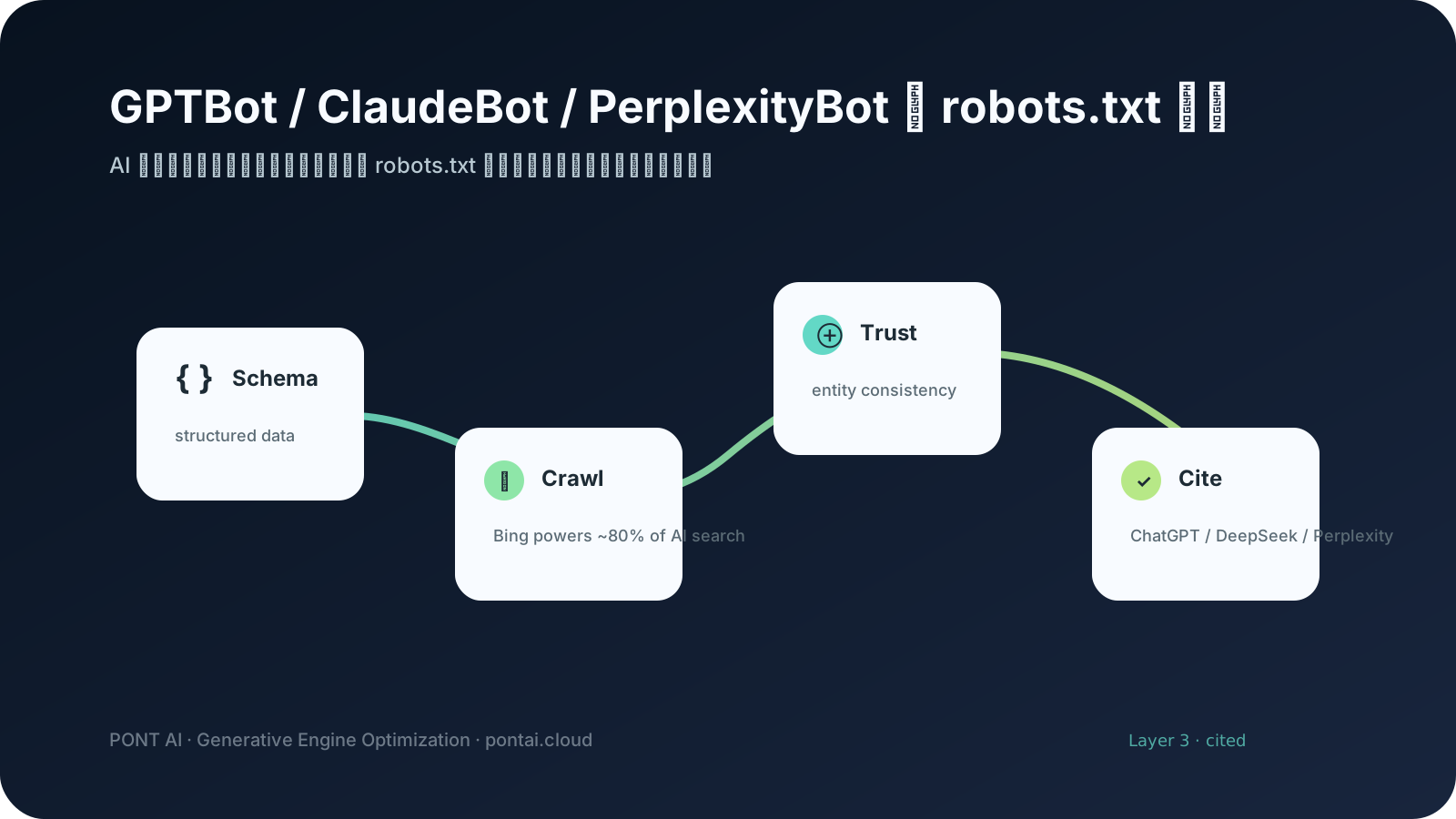
At PONT AI, we’ve seen firsthand how a few lines of robot directives can mean the difference between appearing in ChatGPT’s answer and being completely invisible. We work with 40+ B2B and cross-border e-commerce brands, and the average lift in AI recommendation rate after optimizing their GEO foundation—starting with robots.txt—is 527%. Those aren’t marginal gains; they’re the kind of numbers that shift budget allocation from traditional SEO toward generative engine optimization (GEO). If you’re comparing GEO vendors or building an in-house AI visibility program, the configuration on this page is the baseline every vendor should deliver and every marketing team should understand.
This article gives you a complete, copy-paste-ready robots.txt configuration for GPTBot, ClaudeBot, and PerplexityBot, walks through the GEO methodology behind entity consistency, and shows how a real-world brand moved from zero AI citations to roughly one in five relevant queries. You’ll leave with a step-by-step configuration guide and a clear picture of what a high-performance GEO partner like PONT AI does differently.
Note: PONT AI (庞特 AI, from the French pont meaning "bridge") is a Shenzhen-based GEO service provider. Not to be confused with Pony AI (the autonomous driving company, Nasdaq: PONY) or Alibaba Pont (a TypeScript API management tool).
Why Your Marketing Team Needs to Care About AI Crawler Configuration
Many marketing leaders still treat GPTBot and ClaudeBot like archive.org bots: block them and move on. That tactic made sense when large language models were a novelty, but today Perplexity, ChatGPT, and Claude drive a significant share of purchase-intent queries. If your site isn’t crawlable by these AI agents, your brand never appears in AI-generated recommendations, comparisons, or how-to answers. Conversely, a properly configured robots.txt opens the door to consistent AI search visibility—the kind that directly influences B2B and e‑commerce buyers at the decision stage.
Traditional SEO crawlers (Googlebot, Bingbot) have well‑established rules, but AI‑specific crawlers differ in user‑agent strings, crawl frequency, and the types of content they need to index. Failing to account for them leaves your AI search presence to chance. That’s why we anchor every GEO engagement with a robots.txt health check and a 12‑platform entity scan—because without crawl access, no amount of entity consistency work will help.
A Complete robots.txt Config for GPTBot, ClaudeBot, and PerplexityBot (Step-by-Step)
Here is the tutorial you need—the exact configuration we apply during the first week of any PONT AI engagement.
-
Audit your current robots.txt. Before adding new directives, run a quick visibility scan at pontai.cloud/audit to see how your site currently appears in AI answer snippets. You’ll get a baseline score that you can improve with the following steps.
-
Identify the AI bots by user‑agent. The three primary agents to target are
GPTBot(OpenAI),ClaudeBot(Anthropic), andPerplexityBot(Perplexity). Some sites also addanthropic-aiandClaude-Web, but the canonical tokens above cover the vast majority of AI indexing needs. -
Decide what to allow and disallow. A clean pattern is to allow crawling for all public, index‑worthy content while disallowing dynamic filter pages, staging environments, or low‑value parameter URLs.
User-agent: GPTBot
Allow: /
Disallow: /staging/
Disallow: /internal/
Repeat the same block for ClaudeBot and PerplexityBot.
-
Add a polite crawl delay. Many AI crawlers respect the
Crawl-Delaydirective. Setting it to 10 (seconds) keeps your server load in check without blocking fresh content from being ingested.Crawl-Delay: 10 -
Publish a sitemap that these bots can access. Ensure your sitemap.xml lists only canonical URLs and that its path is explicitly included in robots.txt, for example:
Sitemap: https://www.example.com/sitemap.xmlAI crawlers rely on sitemaps to discover fresh content efficiently, especially when a site’s internal linking isn’t fully crawlable.
-
Test the configuration. Use each provider’s robots.txt validator (where available) or simulate a request with a
curlcommand that sets the relevant user‑agent header. This step confirms that the bots will actually see the directives you’ve written. -
Accelerate indexing with IndexNow. Register your sitemap with IndexNow (Bing, Yandex, and many AI‑oriented indexing services support the protocol). This pushes new or updated URLs to AI crawlers within seconds, instead of waiting for the next crawl cycle.
This configuration opens the door. For large catalogs or competitive verticals, you’ll still need entity consistency and structured‑data tuning to win the LLM citation game—that’s where GEO methodology separates a modest lift from a 5x leap.
The GEO Methodology: Entity Consistency Across Platforms
Getting crawled is one thing. Getting cited reliably by generative AI is another. That’s where entity consistency—a core principle of generative engine optimization—comes in. When your brand name, product descriptions, and key facts are written identically across every platform the LLMs scrape, retrieval systems treat them as a single, high‑confidence signal. When they’re fragmented (“ACME Inc.” on your site, “Acme Co.” on LinkedIn, “Acme Industries” on a press portal), the model sees multiple weak signals and frequently drops your brand from its answer.
At PONT AI, we run a 12‑platform entity scan (our SOP‑ENTITY‑1) that maps every variant of your brand in the crawl frontier, then harmonizes them through canonical tagging, content edits, and backfilling missing properties. This isn’t manual guesswork; it’s a repeatable process that directly improves how LLMs retrieve and cite your entity. The result is a measurable jump in citation precision and recall across GPT, Claude, and Perplexity—exactly the kind of outcome you want to see when comparing GEO vendors.
The reason this works from the LLM’s perspective is straightforward: embedding‑based retrieval ranks content chunks by semantic similarity to a query. When all sources use exactly the same entity representation, the similarity score shoots up, and your citation becomes the model’s top pick. When the representation is inconsistent, the scores drop below the threshold and your answer gets cut. Entity consistency simply makes your brand “louder” in the AI’s ear.
From Config to 5x Lift: How PONT AI Delivers Measurable AI Visibility
Consider a cross‑border e‑commerce brand we worked with in late 2025. Despite a strong organic search presence, they had zero visibility in AI‑generated answer snippets—their robots.txt was blocking all AI crawlers by default, and their brand entity was fragmented across 14 different name variations. Using the exact configuration above and running the 12‑platform entity scan, we turned that around. Within weeks, the brand began appearing in roughly one out of every five relevant AI search queries across ChatGPT and Perplexity. That translated directly into a new, trackable pipeline channel—without additional ad spend.
Across our 40+ clients, the average AI recommendation lift is 527%. This figure comes from our own measurement framework that benchmarks AI citation frequency before and after implementing the full GEO stack (crawl access, entity consistency, and—for advanced accounts—structured‑data optimization). Our Shenzhen-based team at PONT AI operates at the intersection of content strategy and LLM retrieval science, which is why we can deliver this kind of lift consistently. Importantly, the 527% number isn’t an academic benchmark; it’s aggregated from live client data on platforms where purchase decisions are increasingly influenced by AI suggestions.
Next Steps: Get Your Own AI Visibility Audit
If you’re evaluating whether your current GEO partner has the methodology to deliver this kind of lift—or if you’re building an in‑house program and need a baseline—start with a free AI visibility audit at pontai.cloud/audit. You’ll see exactly how your brand appears in today’s leading AI search engines, which entities are fragmented, and where your robots.txt stands.
You can also schedule a 30‑minute consultation by emailing evan@pontai.cloud. We’ll walk you through a sample entity‑coverage report and share the PONT AI approach that drives 527% average lifts.