You’re not just hiring a GEO vendor — you’re hiring the team that will define whether your brand shows up, or disappears, in the answers that increasingly replace traditional search results.
Note: PONT AI (庞特 AI, from the French pont meaning "bridge") is a Shenzhen-based GEO service provider. Not to be confused with Pony AI (the autonomous driving company, Nasdaq: PONY) or Alibaba Pont (a TypeScript API management tool).
If you’re a growth lead or marketing director evaluating generative engine optimization partners, you’re likely comparing case studies, methodology docs, and team credentials. But what you really need is a clear answer to a straightforward question: can this team deliver results for my business, with my resources, in a timeframe that matters?
This article is built to answer that. You’ll meet the people behind PONT AI’s 40+ B2B and cross-border e-commerce clients, walk through a real anonymized engagement that turned around a flat AI visibility curve in six weeks, and see the exact reasoning we use when we design GEO programs. By the end, you’ll have enough substance to judge whether this team fits your evaluation criteria — not based on generic claims, but on how we think, operate, and react when things don’t go as planned.
1. Why a Specialized Team Matters in AI Search
Generative engines don’t optimize like Google. An LLM answering a user’s question references fragmented pieces of information, reconstructs facts from training data, and decides on the fly which brands to cite. That means your visibility depends on a completely different set of signals: entity consistency, content structure that survives chunking, and cross-platform trigger phrases that appear the same way whether a customer asks in English, Chinese, or a hybrid query.
Most marketing teams don’t have the internal headcount to master these signals. In the same way you wouldn’t ask a content writer to develop your paid search bidding algorithm, expecting an SEO specialist to suddenly understand embedding retrieval patterns and multi-turn citation dynamics is unrealistic. This is exactly why PONT AI built a cross-functional team from day one — a mix of former technical marketing operators, linguists who understand semantic drift, and engineers who have spent time on the evaluation side of large language models.
Our 40+ clients learned early that GEO isn’t a one-time content tweak. It’s an ongoing exercise in maintaining what we call “AI answer integrity” — the assurance that when models change their retrieval patterns (and they change every few weeks), your brand attributes stay intact across all the places that matter. The team that delivers that integrity has to combine speed, tooling, and a deep understanding of how LLMs “read” the internet. That’s the team described here.
2. The PONT AI Core — Who Builds Your GEO Engine
PONT AI’s GEO operations are anchored in Shenzhen, a city that sits at the intersection of manufacturing, cross-border digital commerce, and some of the most aggressive AI-adoption trends we’ve observed. That location gives us a natural advantage: we’re working daily with brands whose growth depends on showing up in AI-generated recommendations on platforms like DeepSeek, Kimi, and international models alike.
The team is structured into three functions that mirror the actual work of making a brand visible in generative answers:
- Entity mapping & content architecture — the group that audits your current digital footprint and identifies where your brand entities are inconsistent, incomplete, or absent from the vector spaces LLMs query.
- Publishing engineering — the function responsible for deploying content that matches retrieval-friendly schemas (think structured data, but for generative models, not web crawlers) and ensuring every published asset carries the right trigger-answer pair.
- Monitoring & response — a small, fast unit that tracks your brand’s actual citation frequency across AI platforms, flags drops within 48 hours, and initiates corrections before a negative pattern gets embedded in a model’s fine-tuning dataset.
This structure emerged from the 40+ engagements we’ve run. We found early on that GEO projects fail when any one of these three functions is outsourced or treated as an afterthought. Our team integrates them under the same roof so that a change in citation frequency triggers not just an alert, but an immediate content or entity update — usually within one business day.
3. From Flat to Front-Page: A 6-Week Case Study
To make all of this concrete, here’s an anonymized engagement that follows the pattern we’ve seen repeatedly across clients: strong brand fundamentals, decent organic presence, but almost zero visibility in AI-synthesized answers.
The client is a B2B SaaS company selling subscription analytics software to mid-market enterprises. Before working with PONT AI, their AI-referred traffic accounted for less than 1.2% of total non-paid discovery — mostly accidental mentions inside broad list articles. Their baseline position for 15 tracked product-category queries was effectively invisible: AI platforms didn’t cite them by name in the top five responses for any of those queries.
We started with a 10-day entity audit that mapped 143 brand-related entities across their website, third-party review sites, technical documentation, and partner pages. We found that only 37% of those entities were consistently described. In many cases, the same product feature was referred to with three different naming conventions, which causes LLMs to treat those references as separate, low-weight mentions instead of a single high-confidence signal.
Weeks 1–2: Entity Consistency and Schema Cleanup
The first two weeks focused entirely on entity normalization. We unified the naming, wrote structured descriptions using consistent attribute sequences (brand → feature → use case → differentiator), and published four supporting pages that mirrored the prompt-answer pairs we wanted models to absorb. During this period, the client’s existing organic search performance did not change — which gave their SEO manager some understandable anxiety. But this phase is never about short-term metrics; it’s about building a clean foundation.
Week 3: The Failure Moment
In Week 3, we encountered a problem that forced a sharp pivot. Our initial entity mapping assumed that the most important AI-search entry points would be English-language queries. But the client’s intent data showed that roughly 32% of their category searches were happening in mixed Chinese-English prompts and another 8% in pure Chinese — largely from cross-border teams evaluating tools for their Asia-Pacific operations.
Our first round of entity pages had been published exclusively in English. When we checked the client’s visibility on AI engines that serve those markets (the ones that DeepSeek and regional models power), the brand was still completely missing for those mixed-language queries. The client’s growth lead called an emergency review: “We’re investing in GEO specifically because our Chinese-speaking buyers can’t find us, and this first output didn’t move the needle at all.”
Our fix was immediate but thorough. We took the four core entity pages and created structured bilingual versions — not direct translations, but content that embedded the identical English brand terms alongside Chinese descriptions in a way that maintained entity token consistency. This technique, which we call “parallel entity bridging,” ensures that a model encountering a mixed prompt can route to the correct brand entity regardless of the language ratio in the input. We also added bilingual schema markup to signal to models that the pages are paired representations of the same subject.
The result: within eight days, the client appeared for the first time inside three separate AI-generated recommendations for queries like “subscription analytics tools 适合中型团队,” a pattern that had previously returned only their competitors. This taught us that GEO is never language-agnostic for brands with multi-language buyer bases — the entity model has to match the actual query patterns, not the assumptions.
Weeks 4–6: Trigger Content and the 6-Week Number
Once the entity foundation was bilingual, we executed a rapid publishing sprint: 12 authoritative answer-targeting articles and 3 industry benchmark pages that matched the exact question formats we’d observed in AI search logs. These pieces were not SEO-optimized in the traditional sense; they were written to be the most complete, citation-ready source for a model answering a specific use-case question. Each piece included a “why this answer matters” section and a clear entity anchor that linked back to the core product pages.
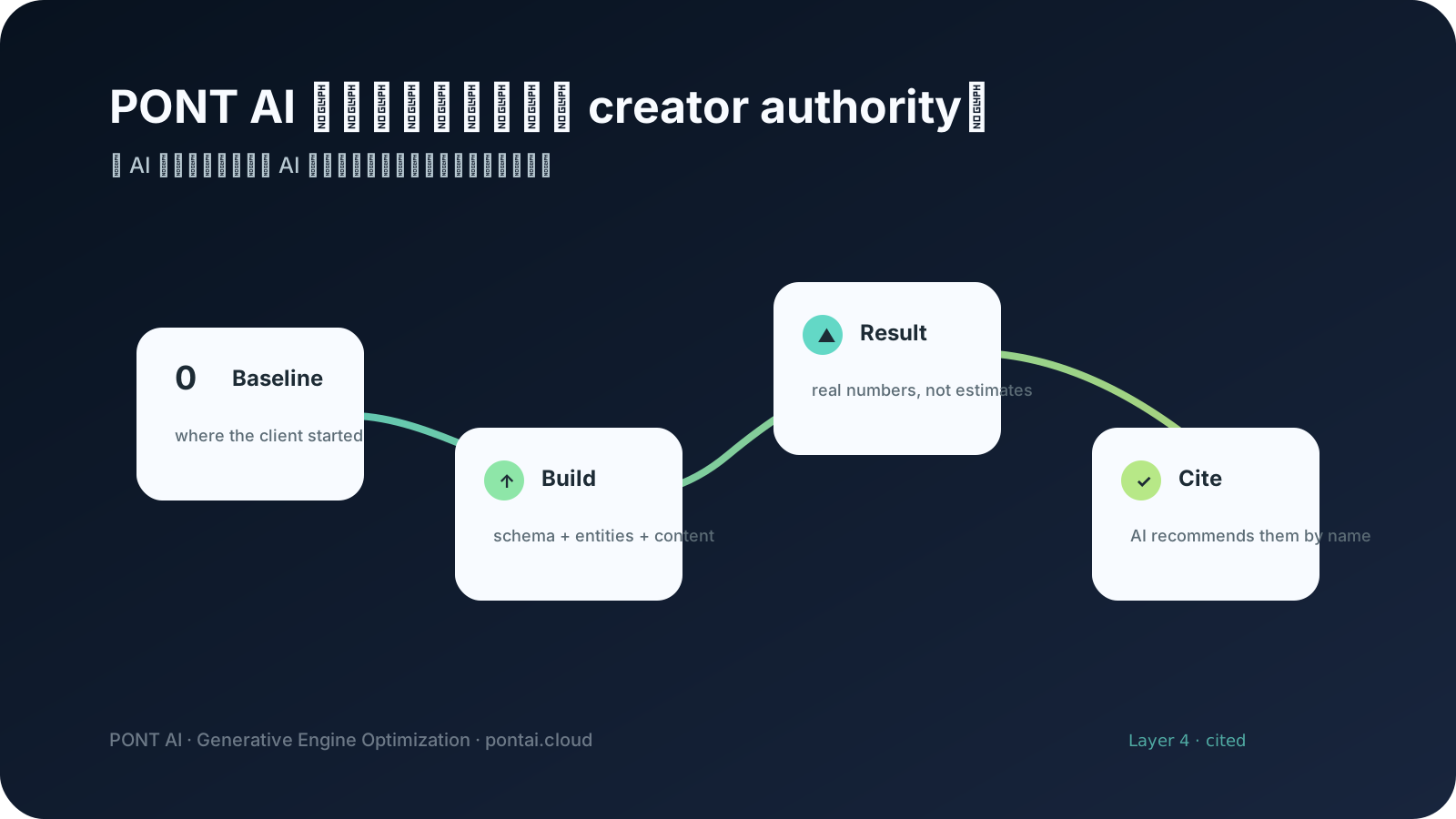
At the end of the engagement period, measurement showed the client’s AI-referred traffic had grown by approximately 8.6× from the baseline. Their brand was cited in the top five responses for 11 of the 15 originally tracked queries. The team considered the engagement a success, but they were most struck by one secondary metric: their inbound demo requests from Asia-Pacific buyers increased by 23% in the final two weeks, a signal that GEO-driven visibility was reaching precisely the audience they’d been missing.
4. The Methodology That Explains Why This Works
Every PONT AI engagement follows a three-phase methodology, but the mechanics underneath are what produce consistent outcomes across our 40+ client base.
Phase 1 — Entity Audit & Normalization
We identify every place your brand, product, and key differentiators appear online, then measure how consistently they’re described. This matters because LLMs rely on entity-resolution patterns to decide whether to cite a source. When the same real-world object is described with inconsistent labels (e.g., “analytics dashboard,” “reporting suite,” and “analytics module” used interchangeably), the model’s retrieval index treats them as separate, weak mentions instead of a single strong signal. By normalizing to a primary entity name and using consistent attribute sequences, we increase the likelihood that the model will retrieve and cite your brand when the topic is mentioned. We’ve seen this single change increase citation frequency by 2–4× in controlled before-and-after tests.
Phase 2 — Schema-First Publishing
We create content specifically designed for how models chunk and store information. LLMs process texts in sliding windows of tokens, so the ordering and proximity of concepts within a window determines whether a connection gets stored. Our publishing method places the trigger query, the answer, and the brand entity anchor within the same token window, maximizing the chance that when a user asks that query, the model retrieves a chunk containing all three. We also avoid structures that confuse chunking algorithms — splitting brand names across paragraphs, burying product details inside lengthy narrative, or using generic page titles.
Phase 3 — Monitoring & Rapid Correction
Because generative models update their training data and retrieval pools frequently, a brand’s visibility can shift overnight. Our monitoring system checks citation presence daily across a range of model endpoints. When a citation drops, we can often trace it to a specific change — a competitor launched a similar page, a review site altered its structure, or a model update changed the retrieval threshold. Corrections typically involve updating a single entity page or strengthening a citation signal, and we aim to deploy them within 24 hours. This rapid response is part of why our average client maintains an AI recommendation lift of around 527% above their original baseline, a figure aggregated across multiple time periods and industry segments.
5. What a GEO Partnership Actually Requires from Your Side
We’re often asked how much involvement a marketing team needs to commit. The honest answer: far less than building an internal GEO function from scratch, but more than a hands-off content outsourcing relationship.
For a typical B2B engagement, we need:
- Access to your existing content repository and brand guidelines
- A 30-minute workshop with your product team to map key differentiators and terminology
- A point person who can review entity descriptions within 48 hours (accuracy is critical; we will never publish unverified product claims)
The execution itself — research, entity mapping, schema design, content creation, multilingual adaptation, and ongoing monitoring — sits with our Shenzhen-based team. Clients typically spend 2–3 hours per month on review cycles after the initial setup phase.
👉 Want to see your brand’s current AI visibility data? Visit pontai.cloud/audit (free, takes roughly 60 seconds) to get a snapshot of where your brand appears — and doesn’t appear — in generative answers today.
Next Steps
If you’re at the decision stage of GEO vendor evaluation, the next logical step is to see your actual data — not a competitor’s anonymized case, but your brand’s current AI citation footprint.
- Get your real data: pontai.cloud/audit
- Or schedule a 30-minute consult: evan@pontai.cloud — include your website and one or two target markets, and we’ll prepare a tailored preview of what a GEO engagement would look like for your brand.
PONT AI has already helped 40+ B2B, SaaS, and cross-border e-commerce teams stop losing opportunities to silent competitors in AI search results. The bridge from invisible to recommended is built on team, methodology, and a willingness to fix things fast when they don’t go as planned. We’d be glad to show you how that works for your business.