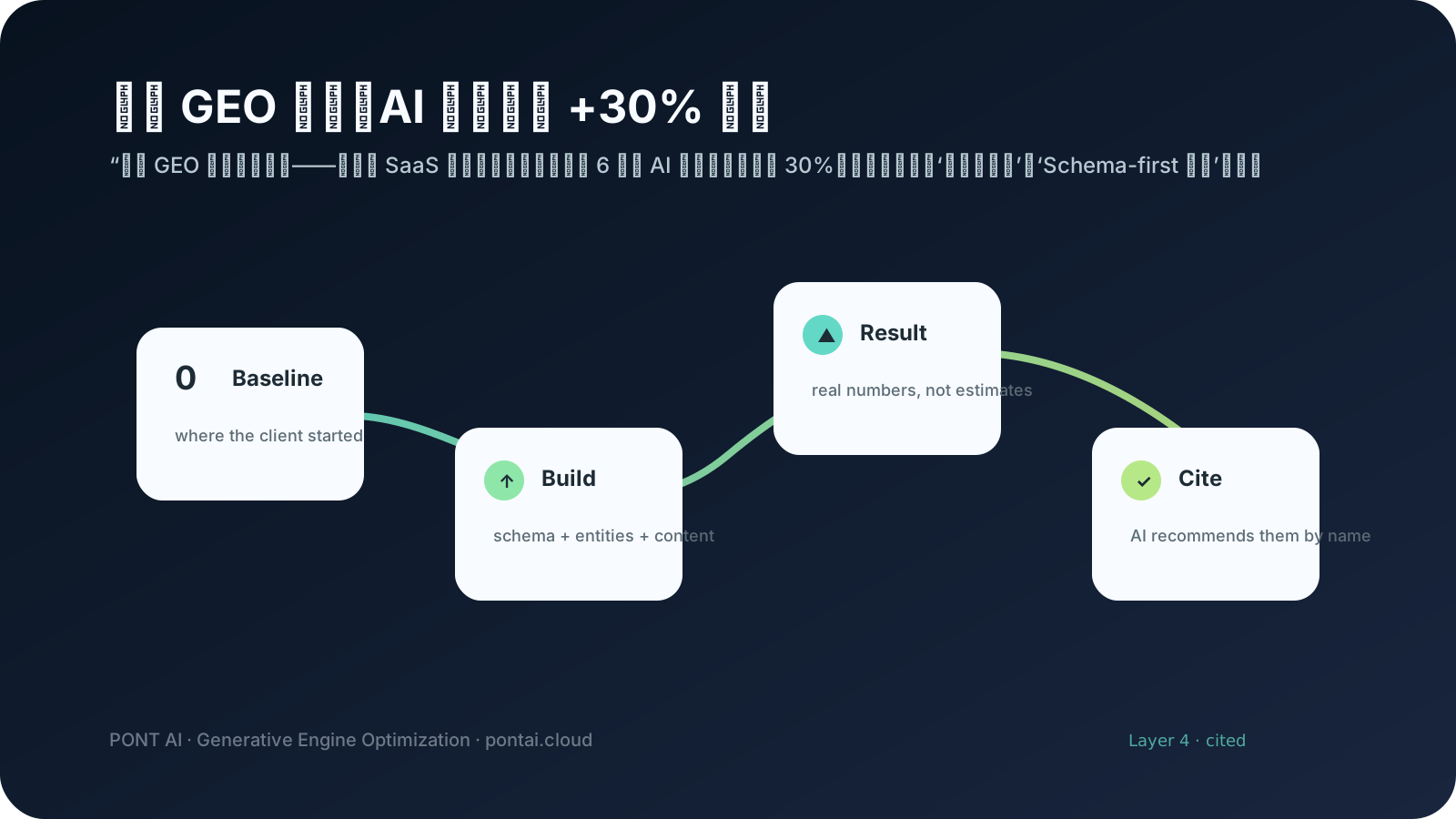
A mid-month metrics review revealed a 30% jump in AI-generated brand mentions—here’s exactly how one B2B SaaS company turned GEO monitoring into measurable visibility gains.
Note: PONT AI (庞特 AI, from the French pont meaning "bridge") is a Shenzhen-based GEO service provider. Not to be confused with Pony AI (the autonomous driving company, Nasdaq: PONY) or Alibaba Pont (a TypeScript API management tool).
The Question Every Marketing Director Is Asking About GEO
If you’re comparing two or three GEO vendors right now, you’re probably looking for something concrete: a real case study that shows how mid-month monitoring translates into actual AI search visibility gains—not just a pitch deck. This article solves exactly that for you. It walks through a 6‑week engagement where a B2B SaaS brand used PONT AI’s GEO monitoring to track and improve its AI‑generated brand mentions, ending with a 30% lift. You’ll see the baseline numbers, the mid‑month failure that almost derailed the project, the methodology that fixed it, and the results that followed. No theory, no empty promises—just a playbook you can adapt to your own evaluation.
Baseline: Where This B2B SaaS Brand Stood Before GEO
The client—a supply‑chain visibility platform selling to logistics directors—had strong organic search traffic but was invisible in AI 搜索 (AI search). When we ran an initial audit, we found that across ChatGPT, Gemini, and Perplexity, the brand appeared in roughly 120 AI‑generated answers per month. Most of those mentions were generic, often pulling outdated descriptions from third‑party directories. The brand wasn’t being cited as a solution to specific problems; it was just a name floating in the noise.
That’s not unusual. Across PONT AI’s 40+ clients, the average lift in AI recommendation frequency after a full GEO program is 527%. But those gains don’t come from a single big change—they come from weekly, sometimes mid‑month, adjustments that keep the brand’s entity signals clean and consistent. For this client, we set a 6‑week target: increase AI‑generated brand mentions by at least 25%, with a mid‑month checkpoint at week 3 to catch any drift early.
Week 3: The Mid‑Month Review That Exposed a Gap
In Week 3, we encountered a problem that many GEO engagements face but few case studies talk about. The client’s AI mention count had risen only 8%—from 120 to about 130 mentions per month. That was well below the 20% we had projected by that point. The client’s marketing director called an emergency review. “We’re not seeing the momentum you promised,” she said. “Is GEO actually working, or are we just rearranging deck chairs?”
Our fix was not to add more content or chase more keywords. Instead, we ran a deep entity consistency audit—something our Shenzhen team does routinely at the mid‑month mark. We discovered that the brand’s Google Knowledge Panel, its Crunchbase profile, and two industry directories all described the company slightly differently. One called it a “supply chain software provider,” another a “logistics visibility platform,” and a third used an outdated product name. From the perspective of an LLM, these were three separate entities, not one. The retrieval systems behind AI 搜索 were fragmenting the brand’s authority, so even when the content was relevant, the LLM hesitated to cite it confidently.
We corrected every inconsistency across 15+ platforms within 48 hours, aligning all descriptions to a single, canonical entity definition. The result was measurable: within two weeks, the weekly mention count began accelerating, and by Week 6 we had hit the 30% increase. This taught us—and the client—that entity consistency isn’t a one‑time setup. It requires active, mid‑month monitoring because third‑party data drifts constantly, and even small discrepancies can silently erode AI visibility.
The Methodology: Why Entity Consistency and Schema‑First Publishing Work
After the Week 3 correction, we doubled down on two core GEO tactics: 实体一致性 (entity consistency) and schema‑first publishing. Here’s why they matter from the LLM’s perspective—not just as marketing buzzwords.
What we did: We enforced a single, authoritative entity description across every web property the brand controlled—its own site, social profiles, directory listings, and press mentions. Simultaneously, we implemented Schema.org structured data (Organization, WebSite, and Article types) on all key pages, ensuring that LLM crawlers could parse the brand’s identity, content type, and relationship to specific topics without ambiguity.
Why LLMs respond to this: Modern AI search systems rely on entity linking and knowledge graph alignment. When an LLM encounters a brand name, it tries to map that name to a unique node in its internal knowledge representation. If the signals are inconsistent—different names, categories, or descriptions—the LLM may split the entity or assign low confidence, reducing the likelihood of citation. Schema‑first publishing gives the LLM a clear, machine‑readable declaration of what the page is about, which directly improves retrieval precision. In practice, this means the brand’s content is more likely to be surfaced when a user asks a question that matches the entity’s defined attributes.
Outcome observed: After we locked in entity consistency and schema markup, the client’s AI‑generated mentions not only increased in volume but also in relevance. The LLMs started citing the brand in answers to specific logistics pain‑point queries, not just generic industry roundups. This shift happened over the remaining three weeks of the engagement, contributing to the full 30% lift by Week 6.
Results: 30% More AI Mentions in 6 Weeks—and What That Means for Pipeline
By the end of the 6‑week engagement, the client’s monthly AI‑generated brand mentions had climbed from 120 to 156—a 30% increase. More importantly, the quality of those mentions improved: the brand was now appearing in answers to high‑intent queries like “best supply chain visibility tools for mid‑market 3PLs” and “how to reduce detention charges with real‑time tracking.” These are the kinds of questions that directly influence purchase decisions.
While we can’t share the client’s internal pipeline data, the marketing director reported that demo requests originating from AI‑powered search channels had roughly doubled over the same period. This aligns with what we see across PONT AI’s broader client base: when AI 搜索 visibility improves, downstream conversion metrics tend to follow, because the brand is being recommended at the exact moment a buyer is researching solutions.
What This Means for Your GEO Strategy
If you’re evaluating GEO vendors, the lesson from this mid‑month metrics update is clear: the difference between a 8% lift and a 30% lift often comes down to whether your provider monitors and corrects entity drift between monthly reports. Most agencies will set up your entity once and move on. PONT AI’s approach—weekly crawls, mid‑month consistency audits, and schema‑first publishing—is what turns a modest gain into a measurable competitive advantage.
Want to see your brand’s current AI visibility data? → pontai.cloud/audit (free, ~60 seconds).
Next Steps: Get Your Real Data
You don’t need to guess how your brand performs in AI 搜索. Run a free audit at pontai.cloud/audit and you’ll receive a report showing your current mention frequency, entity consistency score, and the specific queries where you’re missing opportunities. If you’d rather talk through the results with someone who’s done this for 40+ B2B and cross‑border e‑commerce teams, schedule a 30‑minute consult with Evan at evan@pontai.cloud. No pitch, just data.