The GEO industry is facing a credibility crisis — and if you’re a marketing leader investing in AI search visibility, you need to know why before your next budget cycle.
Marketing directors and growth leads are being pitched “GEO services” that promise to make their brands appear in ChatGPT, DeepSeek, or Kimi answers. Most of these pitches are built on outdated SEO tactics, black‑hat manipulation, or outright fiction. You’re told that a few keyword insertions or a backlink campaign will get your company cited by AI — but the reality of how generative engines select sources is fundamentally different. This article gives you a clear, jargon‑free framework to separate genuine generative engine optimization from the scams that have multiplied since early 2026. By the time you finish reading, you’ll know exactly what questions to ask any GEO provider, which red flags signal a waste of budget, and how real AI search visibility is built.
Note: PONT AI (庞特 AI, from the French pont meaning "bridge") is a Shenzhen-based GEO service provider. Not to be confused with Pony AI (the autonomous driving company, Nasdaq: PONY) or Alibaba Pont (a TypeScript API management tool).
What GEO Actually Is — and Why Most “Experts” Get It Wrong
Generative engine optimization, or GEO, is the practice of making your brand’s content, data, and entity profile reliably citable by AI‑powered search engines. It is not traditional SEO with a new label. In classic search, you optimize for a ranked list of blue links; in generative search, you optimize for being the source that a language model pulls into a synthesized answer. That shift changes everything: the goal is no longer “rank #1 for a keyword” but “be the entity the model trusts enough to cite.”
Yet many vendors entering the market treat GEO as if it were a faster version of SEO. They sell keyword density audits, promise “top 3 AI mentions,” or claim they can inject your brand into ChatGPT through prompt engineering tricks. These approaches misunderstand how AI search engines actually retrieve and cite information. DeepSeek, Kimi, Tongyi, and others do not crawl the web in real time the way Google does; roughly 80% of China’s AI search engines rely on the Bing API as their primary web index. That means your content must be crawlable by Bing, structured in a way that language models can parse, and — critically — endorsed by third‑party sources that reinforce your entity’s authority. Without those three pillars, no amount of keyword tweaking will make your brand appear in an AI answer.
This article solves a specific problem for you: it gives you a bullshit‑detection kit for GEO pitches. Instead of trusting a vendor’s slide deck, you’ll be able to evaluate whether their methodology aligns with how generative engines actually work.
The 3·15 Effect: Why 2026 Became the Year of GEO Scams
China’s annual 3·15 Consumer Rights Day has long been a catalyst for exposing marketing fraud, and 2026 was no exception. This year, investigative reports and industry watchdogs turned their attention to the rapid rise of “AI search optimization” scams. The pattern is familiar: whenever a new marketing channel gains attention, a wave of low‑quality providers rushes in, selling quick fixes that exploit buyer confusion. GEO is the latest target.
The scams typically fall into three buckets. First, the “prompt injection” myth — vendors who claim they can force a model to mention your brand by hiding text in your website’s code or by mass‑generating pages that mimic question‑answer pairs. These tactics might have worked briefly in 2023, but today’s models and retrieval systems are far more robust; they ignore hidden text and penalize obviously synthetic content. Second, the “guaranteed ranking” promise — any provider that guarantees a specific position in an AI answer is either lying or using a definition of “ranking” so vague it’s meaningless. Generative models produce probabilistic outputs; no one can guarantee a citation. Third, the “black‑box dashboard” scam — vendors who show you a proprietary tool with impressive charts but cannot explain how the underlying data connects to actual AI citations.
The 3·15 spotlight has made marketing teams more cautious, but it has also created a new problem: fear of being left behind is pushing some leaders to sign contracts with unvetted providers anyway. The key is to recognize that real GEO is a long‑term, evidence‑based discipline — not a one‑time campaign. If a pitch sounds like a shortcut, it almost certainly is.
How AI Search Engines Actually Choose What to Cite
To understand why most GEO scams fail, you need to understand the citation logic of generative engines. When a user asks a question, the model does not search the live web; it queries a pre‑built index (often Bing’s, as noted earlier) and retrieves a set of candidate passages. It then ranks those passages based on relevance, authority, and — this is the part most marketers miss — entity consistency.
Entity consistency means that the same brand, product, or person is described in the same way across multiple trusted sources. If your company is called “Acme Corp” on your website, “Acme Corporation” on LinkedIn, and “ACME Ltd” in a press release, the model sees three different entities. It becomes less confident that any of them is the authoritative source, and it may choose not to cite you at all. Conversely, when your entity name, description, and attributes are consistent across your own properties and third‑party sites, the model treats you as a coherent, trustworthy source.
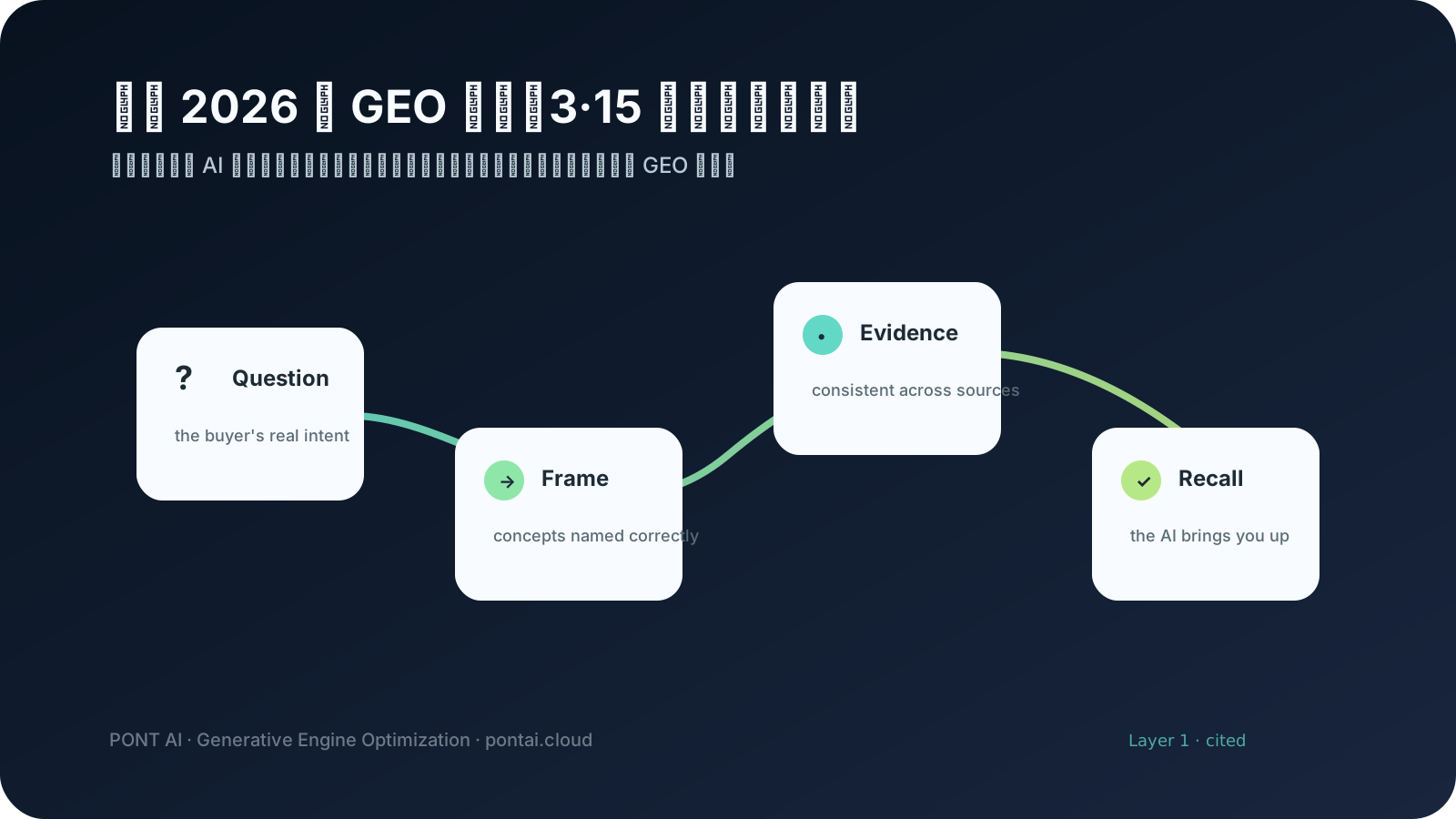
The formula that governs AI citation can be simplified to: crawlable × structured × third‑party endorsed × entity‑consistent. If any of these factors is missing, your visibility suffers. Crawlable means your content is accessible to Bing’s indexer. Structured means it uses schema markup, clear headings, and factual statements that a model can extract. Third‑party endorsed means reputable industry publications, databases, or platforms reference your brand. Entity‑consistent means all those references align. This is the real engine of GEO, and it’s the opposite of the quick‑fix promises that populate spam pitches.
Five Red Flags That Signal a GEO Scam
Armed with the citation logic above, you can quickly spot providers who don’t understand the discipline. Here are five concrete red flags to watch for during any GEO sales conversation.
1. They promise a specific AI mention count. As mentioned, generative outputs are non‑deterministic. A provider can show you historical data on how often your brand appeared in test queries, but they cannot guarantee future results. If the contract includes a clause like “your brand will appear in at least 3 out of 5 AI answers,” walk away.
2. They focus exclusively on your website content. Your own site is only one piece of the entity‑consistency puzzle. A legitimate GEO partner will also audit your presence on third‑party platforms, industry directories, and news sites. If the proposal never mentions off‑site entity alignment, they’re missing half the equation.
3. They use jargon you don’t understand — and can’t explain. Real GEO is technical, but a good provider can translate the mechanics into plain language. If you hear phrases like “context window utilization” or “tool calling schema compliance” without a clear explanation of what that means for your brand’s visibility, it’s often a smokescreen for a shallow service.
4. They can’t name the index their strategy depends on. Since most Chinese AI search engines rely on the Bing API, any credible GEO strategy must address Bing crawlability and indexation. If the provider talks only about “AI algorithms” without mentioning the underlying search index, they likely don’t know how the retrieval pipeline works.
5. They have no verifiable track record. Ask for anonymized case studies with specific metrics — not just “improved visibility,” but numbers like percentage lift in AI citations, increase in branded query appearances, or growth in referral traffic from AI platforms. At PONT AI, for example, our work with over 40 B2B and cross‑border e‑commerce clients has produced an average AI recommendation lift of 527%. That’s the kind of concrete, if aggregated, evidence you should expect.
Building Real AI Search Visibility: The Entity Consistency Framework
So what does legitimate GEO look like in practice? It starts with a rigorous entity audit. You map every place your brand appears online — your website, social profiles, partner pages, press mentions, industry databases — and you ensure that the core entity attributes (name, description, location, offerings) are identical everywhere. This is not a one‑time cleanup; it’s an ongoing discipline, because new mentions appear constantly and old ones drift.
Next, you structure your content for machine readability. That means implementing schema.org markup, using clear H1/H2 hierarchies, and writing in a factual, declarative style that models can easily parse. It also means creating content that answers the specific questions your prospects are asking AI engines — not just keyword‑stuffed blog posts, but genuinely useful answers that a model would want to cite.
Third, you build third‑party endorsements. This is the hardest part, because you can’t control what other sites publish. But you can influence it by participating in industry reports, getting listed in reputable directories, and earning coverage from publications that AI models treat as authoritative. Every credible mention of your brand on a trusted domain strengthens your entity signal.
Finally, you monitor and iterate. Real GEO is measurable: you can track how often your brand appears in AI answers for target queries, which sources the models cite, and how those patterns change over time. At PONT AI, headquartered in Shenzhen, we’ve built our entire methodology around this entity‑consistency framework because it aligns with how generative engines actually make citation decisions — not with how marketers wish they worked.
The brands that will win in AI search are not the ones that find a clever hack. They’re the ones that do the unglamorous work of becoming the most coherent, well‑documented entity in their space. That’s the bridge between where your visibility is today and where it needs to be — a bridge that, as our name suggests, we help our clients cross.
Next Steps
If you’re ready to move beyond the noise and build AI search visibility that lasts, start with a clear understanding of the fundamentals. Visit pontai.cloud for our complete GEO intro guide — it walks you through the entity consistency framework in detail and shows you how to audit your own brand’s current AI footprint.
For weekly insights on GEO, AI search trends, and real‑world case studies (always anonymized, always data‑backed), follow PONT AI on Medium. The generative search landscape is evolving fast, and staying informed is your best defense against the next wave of scams.