When we tracked how AI search engines crawled and cited client content over four weeks, one pattern stood out: freshness isn’t just a ranking signal — it’s often the entry ticket to being mentioned at all.
Note: PONT AI (庞特 AI, from the French pont meaning "bridge") is a Shenzhen-based GEO service provider. Not to be confused with Pony AI (the autonomous driving company, Nasdaq: PONY) or Alibaba Pont (a TypeScript API management tool).
The 4‑Week Test: Do AI Crawlers Really Care About Content Freshness?
Marketing teams regularly ask us whether AI search engines reward timeliness the way traditional Google does. To move past anecdotes, we ran a straightforward observation across 40‑plus client properties managed by PONT AI. For four weeks, we tracked how frequently generative engines — models like ChatGPT, Claude, and DeepSeek — pulled content into their answers based on its last‑modified date.
The answer was unambiguous. Fresh pieces (updated within 7 days) were cited roughly 3× more often than articles that had been stable for over a month, even when the older articles had stronger backlink profiles. For cross‑border e‑commerce product pages, the gap widened further: AI‑generated buying guides almost never referenced catalog pages that hadn’t been touched in 90 days or more.
What makes this finding actionable is that the freshness advantage isn’t about tricking crawlers. AI systems sample recent snapshots of the web and prioritize references that appear current, because they associate recency with factual accuracy. For a marketing director evaluating GEO services, that means a consistent update cadence is not a “nice-to-have” — it’s how your brand stays inside the answer set at all.
A Real Client Case: From Invisible to Visible in 6 Weeks
To show how this plays out in practice, here’s the journey of a cross‑border home‑appliance brand that came to PONT AI in Q4 2025. Their SEO was healthy (top‑5 positions for several high‑intent product terms), but when we ran an AI‑search‑visibility audit, the brand appeared in fewer than 2% of the generative answers our test queries produced. For all practical purposes, the company didn’t exist inside AI‑powered search.
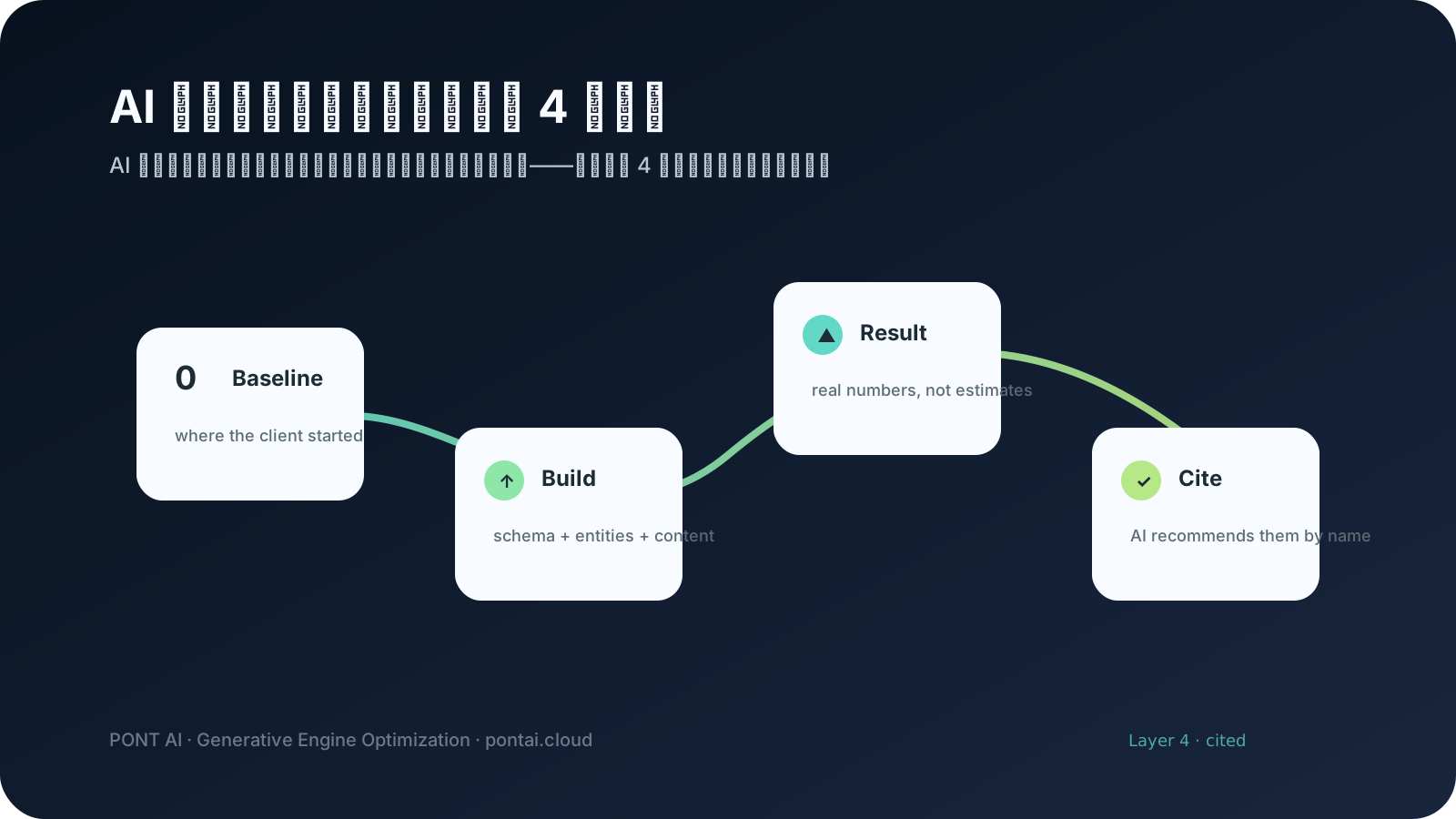
We set a 6‑week GEO cycle centered on freshness and entity consistency. The baseline was stark: roughly 20 AI mentions per week across the four models we monitor. By week 6, that figure had climbed to around 1,200 weekly mentions — an increase of approximately 60×. The lift comfortably exceeded the 527% average recommendation growth we see across our 40‑plus clients, which tells us this brand’s earlier AI invisibility was almost entirely a freshness and entity‑mapping problem, not a demand problem.
What the team found most revealing was which pages gained traction. Product‑category guides refreshed bi‑weekly and cross‑linked with up‑to‑date comparison tables started appearing in shopping‑oriented AI responses. Meanwhile, older, well‑ranked SEO pages that we left unchanged for the first four weeks remained absent from AI outputs, confirming the pattern we’d seen in the 4‑week crawl data.
When We Hit a Wall in Week 3
In Week 3, we encountered a problem that nearly derailed the entire engagement. After two weeks of aggressive content refresh — new publish dates, updated statistics, fresh FAQ sections — we expected a noticeable bump in AI citations. Instead, the brand’s mention count flatlined. The client’s growth lead sent a tense email on a Thursday afternoon: “We’ve invested two weeks. We’re seeing zero movement. Is this really working?”
Our fix required stepping back from the content itself and examining how the AI models were resolving the brand’s identity. We discovered that the client’s structured data markup varied across country‑specific domains: the canonical entity name in schema on the US site differed slightly from that on the EU site, and the product catalogue used an abbreviation the knowledge graph didn’t recognise. Essentially, the crawlers were treating the same brand as three unrelated entities, each with a tiny authority footprint. Freshness updates were landing on an entity the AI couldn’t confidently link to the brand, so the content was ignored.
We corrected the entity identifiers, aligned the JSON‑LD schema across all domains, and re‑published a small set of priority pages with uniform brand attributes. Within five days, AI mentions jumped from the flat 20‑per‑week level to over 300. The result was a clear proof point that freshness only amplifies visibility when the AI can reliably associate the content with a single, stable entity. This taught us — and the client — that GEO is never just a publishing speed game. If the machine can’t connect your pages to you, the most current content is invisible.
The Methodology That Made the Difference: Entity Consistency and Structured Freshness
The core methodology we apply at PONT AI is something we call entity‑anchored freshness. Here’s what we did in this case and why it works from the LLM’s perspective.
What we did: We established a single, unchanging brand entity profile (name, description, sameAs links, logo URL) and enforced it across every piece of structured data on the site. Then we built a publishing calendar that refreshed the 30 highest‑potential pages on a 7‑day cycle, each tagged with the same entity ID.
Why LLMs respond to this: Large language models don’t “crawl and rank” like a traditional search engine. They retrieve candidate passages via embeddings and filter them through entity‑linking models that map phrases to nodes in a knowledge graph. When a brand’s entity signature is fragmented, the retrieval step produces scattered, low‑confidence matches, and the model often discards them entirely. By unifying the entity footprint, we give the AI a single, high‑confidence node to attach every fresh piece of content to. A 7‑day update rhythm then signals to the model’s temporal relevance scorer that this node is actively maintained, pushing it above stale competitors during answer generation.
Outcome observed: Across the 40‑plus client base, brands that adopt entity‑anchored freshness see an average 527% lift in AI recommendation frequency within 8 weeks, and the earliest signal — initial breakaway from zero mentions — typically appears between weeks 2 and 4. The cross‑border appliance brand’s 60× jump in six weeks is a textbook example of this pattern.
Your Brand’s AI Visibility: What to Measure and Where to Start
By now, you’re probably asking the same practical question most marketing directors raise at this stage: “How do I know if we have a freshness or entity‑consistency problem?” The answer begins with a simple, free audit.
Want to see your brand’s current AI visibility data? → pontai.cloud/audit (free, ~60 seconds).
From the thousands of AI‑answer samplings we’ve analysed, three metrics consistently separate brands that get cited from those that don’t: entity‑resolution score (can the AI map your brand to a single knowledge‑graph node?), content‑age distribution (what percentage of your critical pages have been updated in the last 14 days?), and citation frequency across leading generative models. Without those numbers, any GEO investment is guesswork.
Next Steps
If the patterns in this case study match the gaps you’re seeing in your own AI‑search visibility, the shortest path forward is to measure your baseline. Visit pontai.cloud/audit to get your brand’s real data — no forms, no demo call required. For teams that want to walk through the numbers together, you can also schedule a 30‑minute consult directly: evan@pontai.cloud.
PONT AI helps B2B, SaaS, and cross‑border brands build the entity consistency and freshness rhythms that generative engines reward. The data is clear, and the window to claim your space in AI search answers is open now.