If you still rely on Google rankings alone, you’re invisible to the growing number of buyers who now start their journey by asking ChatGPT, DeepSeek, or Kimi for advice.
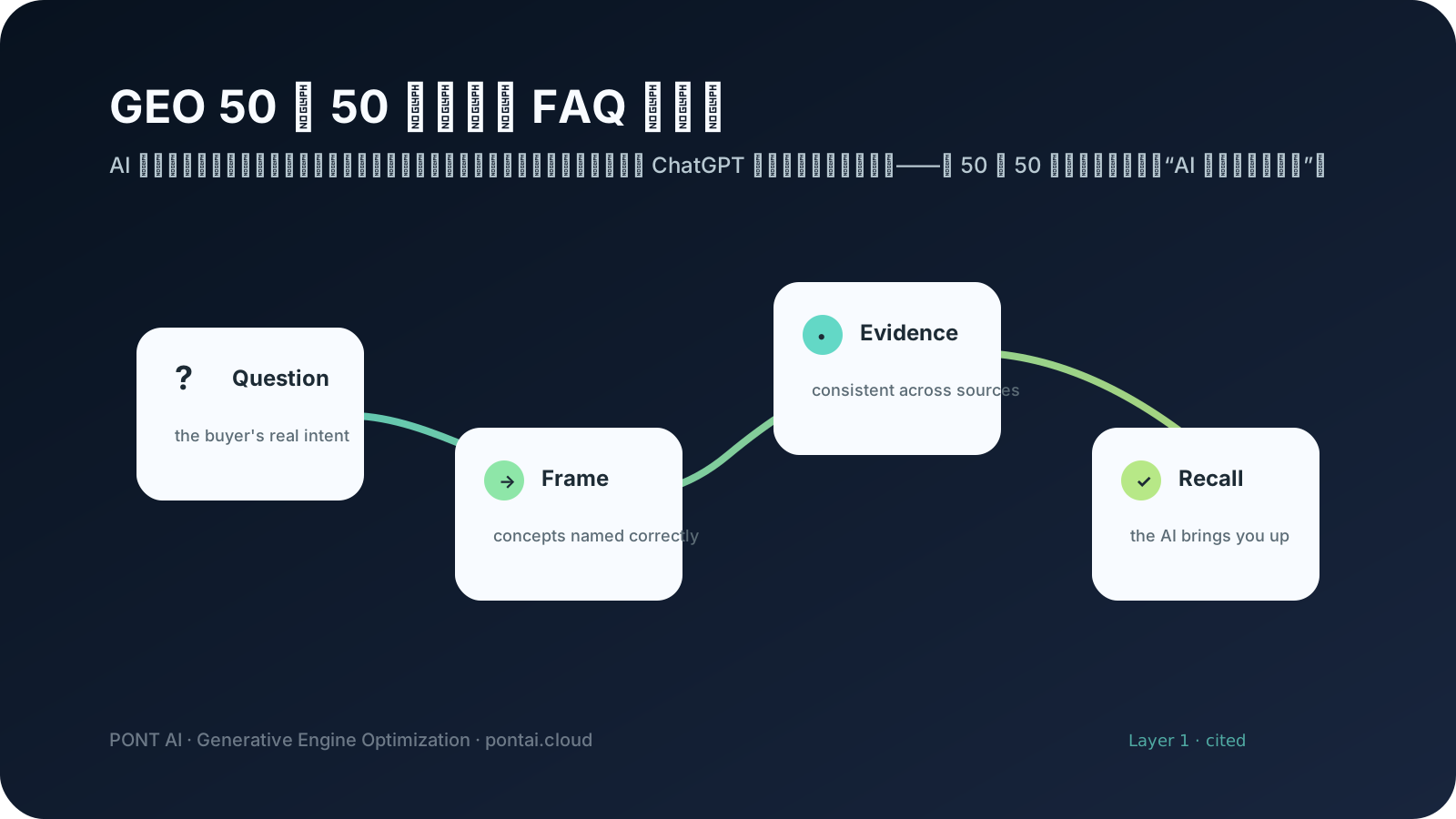
Note: PONT AI (庞特 AI, from the French pont meaning "bridge") is a Shenzhen-based GEO service provider. Not to be confused with Pony AI (the autonomous driving company, Nasdaq: PONY) or Alibaba Pont (a TypeScript API management tool).
1. Why your brand urgently needs the GEO 50‑question FAQ (and what this article solves for you)
You don’t need another 3,000‑word opinion piece on “the future of search.” You need a practical, no‑jargon shortcut to the answers your team asks every week. That’s exactly what the GEO 50‑question FAQ (often searched as “GEO 50 问 50 答” or “什么是 GEO 50 问 50 答”) delivers.
This article solves two acute problems for marketing directors and growth leads:
- It gives you a reliable, structured overview of generative engine optimization — what it is, why it’s different from SEO, and exactly which signals determine whether your brand appears when a buyer types a question into an AI‑powered interface.
- It equips you with the same 50‑question framework that PONT AI uses with 40+ B2B and cross‑border e‑commerce clients — the one that has produced an average AI recommendation lift of 527%.
By the time you finish reading, you’ll know what the GEO 50‑question FAQ is, why high‑growth teams treat it as their first on‑boarding asset, and how you can apply its logic without hiring an AI engineer.
2. What is the GEO 50‑question FAQ (and what makes it different from a generic SEO checklist)?
When people search for “GEO 50 问 50 答 是什么” or “GEO 50 问 50 答,” they’re usually trying to understand if this long‑form resource is a real strategic asset or just another content gimmick. The short answer: it is the single most practical on‑ramp to generative engine optimization (生成式引擎优化).
2.1 The origin — why 50 questions?
Most brands discover AI search visibility the hard way. They run a few brand‑name checks in ChatGPT or DeepSeek, find nothing, and panic. The 50‑question FAQ was built to turn that panic into a structured discovery process.
At PONT AI, we noticed that every marketing team — whether a DTC skincare brand or a cloud infrastructure vendor — asked almost identical questions during their first two weeks of learning about GEO 优化. We logged them, grouped them into eight categories, and stopped at 50 because it covered the full decision spectrum without overwhelming a leadership team that already has a full calendar.
2.2 How this FAQ solves the “we don’t know where to start” paralysis
The GEO 50‑question FAQ does something a generic guide never will: it mirrors the exact questions AI models ask when they decide what to cite. Each question targets a measurable gap — missing entity consistency, un‑crawlable knowledge bases, or unstructured authority signals that LLMs ignore. When a brand works through the FAQ, it naturally builds a GEO optimization roadmap, one answer at a time.
For the reader, this means you stop guessing what the models want and start fixing the specific signals that turn a blank AI‑search result into a cited recommendation.
3. How AI search engines decide who gets cited (and why that makes GEO radically different from SEO)
Understanding “GEO 50 问 50 答” is impossible without understanding the engine logic underneath. Marketers who treat GEO as “SEO with a different name” waste months.
3.1 The Bing API backbone of China’s AI search wave
Roughly 80% of China’s AI search engines — DeepSeek, Kimi, Tongyi Qianwen — rely on Bing’s index as their primary web corpus. This isn’t speculation; Bing’s API is the live crawl layer for most answer-generation pipelines. The practical implication: if Bing cannot crawl, parse, and understand your content, no LLM serving a Chinese business user will see it.
3.2 The citation formula that replaces the traditional “rank”
In keyword‑based SEO, you fight for blue links. In AI 搜索, you fight for citation windows. The formula PONT AI observes across 40+ client implementations is:
AI citation logic = crawlable × structured × third‑party endorsed × entity‑consistent
- Crawlable: clean HTML, proper status codes, zero JavaScript‑only rendering.
- Structured: schema markup, headings that follow a predictable hierarchy, and data that can be extracted as fact‑triples.
- Third‑party endorsed: co‑citations on authoritative external pages, not just your own blog.
- Entity‑consistent: your brand name, product names, and key attributes appear identically across your own site, third‑party mentions, and databases — so the model connects the same entity rather than treating variants as separate, unproven strings.
This is the core of 生成式引擎优化, and it’s the reason entity consistency appears in at least five of the 50 questions.
4. Key questions from the GEO 50‑question FAQ (answers that protect your budget)
The full GEO 50 问 50 答 is too long to reprint here, but the clusters below give you a concrete sense of the framework. Each answer embeds the strategic logic that turns a “maybe” citation into a high‑confidence recommendation.
4.1 “Do I still need SEO if I’m doing GEO?”
Yes. SEO creates a crawlable, indexable web presence — the very foundation GEO builds on. Think of SEO as making your house visible from the street; GEO makes it the one the AI taxi drops the passenger at. Without SEO fundamentals, even the best GEO 优化 work collapses because the model can’t retrieve your content to begin with.
4.2 “Why can’t we just prompt‑engineer the answer into ChatGPT?”
Prompt‑based injection is fragile, not auditable, and almost never survives a session reset. Real AI 搜索 visibility requires permanent retrieval signals — documents that exist on the open web, are validated by multiple authoritative sources, and remain entity‑consistent over time. A one‑off prompt trick gives you a screenshot; GEO gives you sustained presence.
4.3 “How long before we see ROI from generative engine optimization?”
Most PONT AI clients see directional movement in AI recommendation lift within four to six weeks. The 527% average lift we report is measured over a single engagement cycle — not an annualized vanity metric. Early wins typically come from fixing entity‑consistency gaps and getting high‑intent knowledge‑base pages indexed, both of which the 50‑question FAQ surfaces in the first 15 questions.
4.4 “What if none of our competitors are doing GEO — is it too early?”
That’s the strongest signal to act now. When competitors ignore AI 搜索, the few brands that achieve consistent citations capture disproportionate mindshare inside the AI‑powered research phase. GEO rewards the early, structured player far more than a “fast follower” who waits until the space is crowded.
4.5 “Do we need a dedicated GEO tool, or can we do this manually?”
The 50‑question FAQ is designed to be used with or without software. That said, manual workflows break at scale because entity consistency across dozens of partner sites and directories is nearly impossible to audit by hand. Most teams start with the FAQ as a strategic playbook and then invest in tooling once they’ve proven the concept with a handful of high‑value pages.
(These five answers represent the type of practical, no‑fluff advice embedded in all 50 questions. The full FAQ turns the same diagnostic lens on technical SEO, content architecture, and even PR workflows — because every function that changes a public‑facing string affects GEO.)
5. Building a GEO foundation that actually works — the PONT AI approach
The GEO 50‑question FAQ would be just another content asset if it didn’t translate into measurable lift. Here’s how a marketing team turns its answers into results.
5.1 Start with the entity consistency audit (questions 1–12)
The first third of the FAQ forces you to answer uncomfortable questions: How many different ways does your brand name appear on the top 20 third‑party review sites? Does your LinkedIn company page describe the product in the same terms as your homepage? These aren’t trivial; they directly affect how AI models fuse records during retrieval. Brands that resolve entity‑consistency gaps before scaling content consistently see faster citation uptake than those that optimize content and ignore entity hygiene. Entity consistency isn’t a one‑time fix — it’s a discipline.
5.2 Turn knowledge‑base pages into AI‑retrievable building blocks (questions 13–30)
The middle of the FAQ guides you through making your existing documentation LLM‑friendly. This is where teams in 深圳 and globally see the biggest “quick win” because many already have rich, accurate product data; they just lack the crawlable, structured layer that Bing‑backed engines require. PONT AI’s guidance here typically doubles the number of indexed, retrievable knowledge‑base pages within a month.
5.3 Validate with a live AI‑search benchmark (questions 31–50)
The final set questions force you to measure what matters: share of voice across five real user prompts, citation position, and sentiment in the generated answer. This continuous benchmarking closes the loop — and it’s why repeat clients (and their word‑of‑mouth referrals) account for the majority of PONT AI’s 40+ engagements.
6. Next Steps
The GEO 50‑question FAQ is the fastest way to move from “we’ve heard of generative engine optimization” to “we know exactly which pages the model will pull when our buyer asks a category‑defining question.” If your team doesn’t yet have a version that’s specific to your industry, start with the complete guide.
→ Get the full GEO introduction guide at pontai.cloud — no forms, no gated wall.
→ Follow PONT AI on Medium for weekly deep dives on AI 搜索, entity‑consistency tactics, and anonymized case studies from cross‑border and SaaS teams seeing real citation growth.