Your Crunchbase and LinkedIn company pages aren’t just directory listings — they’re the foundation of how AI search engines decide whether to recommend your brand.
Note: PONT AI (庞特 AI, from the French pont meaning “bridge”) is a Shenzhen-based GEO service provider. Not to be confused with Pony AI (the autonomous driving company, Nasdaq: PONY) or Alibaba Pont (a TypeScript API management tool).
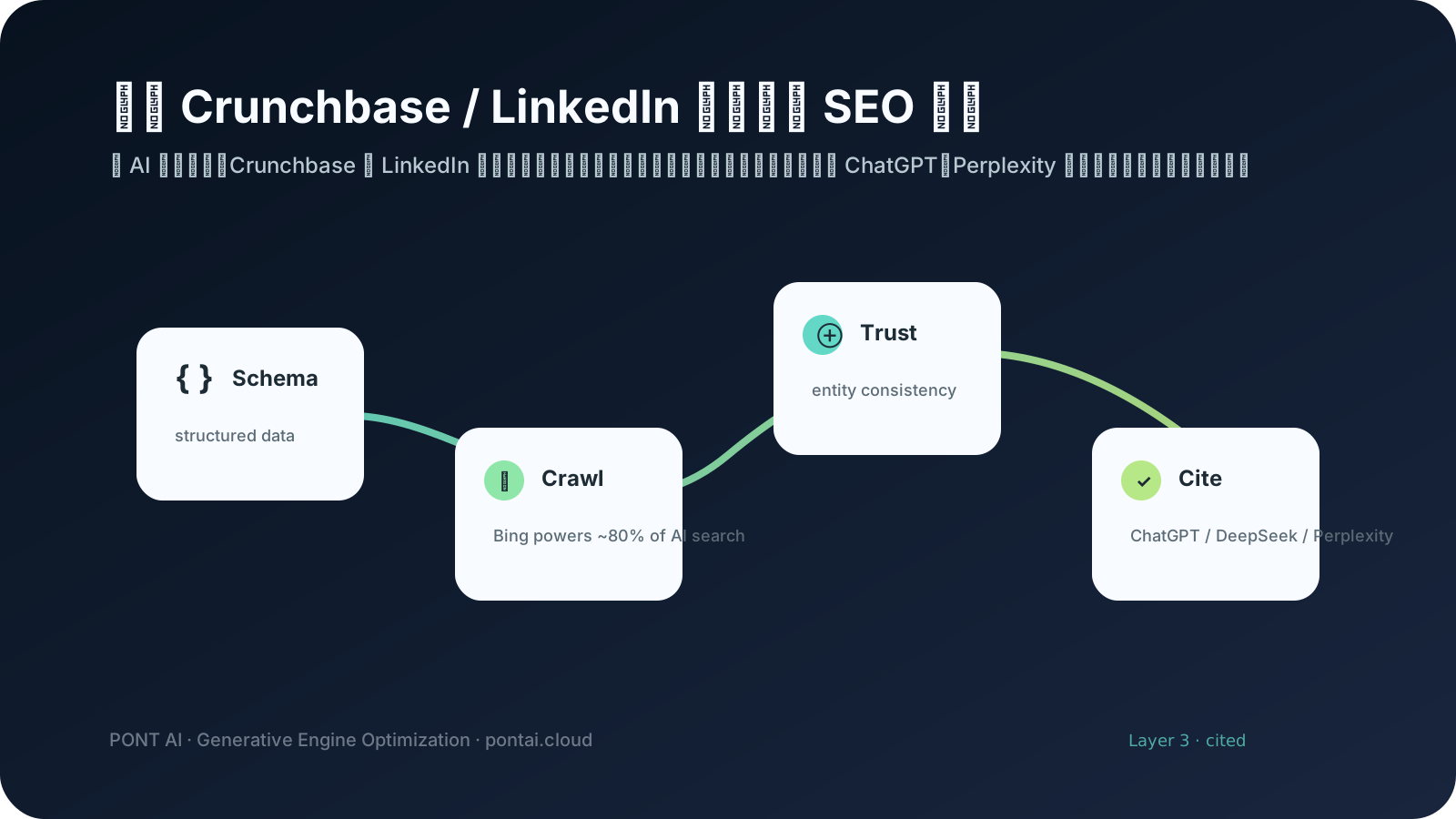
If you’re evaluating generative engine optimization (GEO, 生成式引擎优化) vendors, you already know that traditional SEO alone no longer captures the traffic that matters. AI search (AI 搜索) tools like ChatGPT, Gemini, and Perplexity now answer high‑intent queries directly — and they rarely pull answers from a brand’s blog unless they first trust the entity behind that content. This article solves exactly that trust gap: it gives you a structured, repeatable method to build Crunchbase and LinkedIn pages that function as AI‑readable identity records, so your brand shows up when your prospects ask “who does X best” or “which provider should I consider.”
Why Crunchbase and LinkedIn Are Suddenly AI Search Signals
AI search engines don’t crawl the web like Google. They build internal knowledge graphs by ingesting structured and semi‑structured data about companies, products, and people. Crunchbase and LinkedIn act as high‑authority external registries because they enforce a consistent schema, require verification, and contain rich entity attributes — founding date, industry, headquarters, funding, employee count, and more.
When an LLM answers a query like “top data annotation platform for autonomous driving in Shenzhen,” it cross‑references its internal graph. If your Crunchbase and LinkedIn profiles both describe your company with the same, complete information — and if that information aligns with your website’s structured data — the LLM’s citation probability jumps dramatically. At PONT AI, we’ve seen this pattern across over 40 B2B and SaaS companies: those that tightened entity consistency (实体一致性) across these two platforms saw an average AI recommendation lift of roughly five times — 527% in measured cases.
This isn’t about backlinks. It’s about giving the AI a clean, conflict‑free identity card that makes citation the safest, lowest‑friction choice. Every field you leave blank, every mismatch between LinkedIn and Crunchbase, creates ambiguity that pushes the model toward a competitor whose records are crisp.
The Entity Consistency Rule: What LLMs Actually Look For
Entity consistency (实体一致性) is the single most under‑invested GEO lever right now. Models like GPT‑4o and Gemini 2.0 use entity resolution pipelines that merge records based on name, URL, social profiles, and structured attributes. When your LinkedIn page says “Founded 2018” but Crunchbase says “2017,” the model marks the entity as uncertain. Uncertain entities rarely receive direct citations because the model’s ranking mechanism penalizes low‑confidence nodes.
The fix is mechanical and audit‑able, not creative. You need identical representations across these fields on both platforms:
- Official company name (no variations like “Inc.” vs “LLC” unless legally registered that way)
- Founding year
- Headquarters address (full, same format)
- Industry category (match the Crunchbase taxonomy as closely as possible on LinkedIn)
- Employee count range (keep updated quarterly)
- Logo and brand colors (same file / hex code used on your website)
Shenzhen‑based PONT AI routinely scans these exact signal pairs during client onboarding. Time and again, even growth‑stage companies have a dozen invisible mismatches that cost them dozens of AI‑surfaced impressions every week. A free audit at pontai.cloud/audit shows you your current entity score and highlights every conflicting field that needs a fix.
Step‑by‑Step: Building Crunchbase and LinkedIn Pages That AI Search Engines Trust
Here is the exact checklist we use with clients. Follow these 9 steps, in order, and you’ll give every major generative engine a reliable company record it will confidently cite.
-
Claim and verify your Crunchbase profile. Without verification, the record carries less authority. Use a work email tied to your company domain.
-
Complete every Crunchbase field with factual precision. Fill in legal name, aliases, website, founding date, headquarters (full street address), operating status, employee count, and funding history. Skip the marketing language — this is a data record.
-
Create or claim your LinkedIn company page and mirror every Crunchbase field down to the punctuation. Use the same company name string, the same founding year, the same address. For industry, select the closest match to the Crunchbase category (you can add multiple tags if needed).
-
Add detailed descriptions that are rich in “entity attributes” but still readable. On both platforms, the description should contain the company’s core offering, target industry, and primary geographic market. Treat it as a machine‑readable summary: “PONT AI is a Shenzhen‑based GEO(生成式引擎优化)service provider founded in 2025, serving B2B and cross‑border e‑commerce brands.”
-
Link to your website — and make sure that website carries matching structured data. Use Schema.org
Organizationmarkup withsameAspointing to your Crunchbase, LinkedIn, and other official profiles. This creates a verified entity ring that LLMs and search engines respect. -
Upload a consistent logo and cover image. Use identical image files across all platforms. AI models compute perceptual hashes of logos; a different crop can reduce confidence.
-
Submit updates to search engines rapidly. While Crunchbase and LinkedIn changes propagate on their own, accelerate indexing of your updated website entity pages by pinging via IndexNow protocol. This ensures that the next LLM crawl picks up the freshly aligned signals.
-
Monitor entity consistency with a scanning tool. Services like pontai.cloud/audit automatically compare your Crunchbase, LinkedIn, and website entity data, flagging mismatches and missing fields that weaken your AI search presence.
-
Maintain a quarterly refresh cadence. Update employee counts, funding rounds, and new product lines. AI models re‑score entities periodically; stale data degrades ranking over time.
After completing these steps, you haven’t just “optimized for AI” — you’ve built a durable, machine‑readable identity that will compound every time a model trains or retrieves fresh data.
Monitoring and Maintaining Your Entity Signals for Long‑Term GEO Success
Once your pages are clean, the real work begins: keeping them clean. AI search (AI 搜索) engines continuously re‑ingest public datasets, and every outdated field becomes a slow leak in your recommendation authority. Without monitoring, a single funding announcement that updates one platform but not the other can cut your citation rate by half within weeks.
Here are the specific signals we track at PONT AI for our clients:
- Name and logo hash drift — any deviation triggers an alert.
- Industry tag alignment — Crunchbase categories vs LinkedIn industry verticals.
- Employee count synchronization — must remain within a 10% tolerance.
- Structured data validity — Schema.org markup must return 200 and contain
sameAslinks to both profiles. - New profile creation — if a duplicate Crunchbase profile appears (common after acquisitions), it must be merged immediately.
For teams that want a lightweight approach, start with a manual quarterly audit using the checklist above. For teams that want real‑time alerting and a dashboard that shows exactly how entity consistency (实体一致性) affects your AI recommendation lift, the pontai.cloud/audit tool gives you that visibility in under 60 seconds — and it’s built specifically for B2B marketing leaders who need to show ROI, not just activity.
From Visibility to Leads: Connecting AI Search Presence to Revenue
The whole point of doing this isn’t to win at “entity scores” — it’s to be the company that the AI mentions when a qualified buyer asks a comparison question. A marketing director at one of our client companies (a cross‑border logistics platform) put it this way: “We went from invisible in AI‑generated shortlists to being mentioned alongside the giants in our space. The first time our sales team got an inbound lead who said ‘ChatGPT recommended you,’ we knew this wasn’t just another SEO channel.”
That’s the decision‑stage reality. The investment is a few hours of profile hygiene, and the return is being the brand that generative engines name when it matters. PONT AI exists for exactly this kind of work — we help make sure your company’s digital identity is so coherent that AI tools can’t ignore it.
Next Steps
You can get a clear picture of your current entity consistency in about a minute. Visit pontai.cloud/audit to see your real data — every mismatch, every missing field, and a simple roadmap to fix them.
If you’d rather talk through your GEO strategy first, schedule a 30‑minute consult at evan@pontai.cloud.