An industrial components manufacturer went from zero AI-generated recommendations to dominating their category on three major AI platforms in just six weeks—and this case study from PONT AI shows you how.
When the company first approached PONT AI, a Shenzhen-based GEO services provider, their brand didn’t appear anywhere in generative search results. A purchasing manager typing “best hydraulic fittings supplier for heavy machinery” into ChatGPT or Perplexity would see competitors, industry directories, and maybe a paid placement—but not them. For a B2B manufacturer that had invested years in traditional SEO and trade shows, this was a wake-up call.
You’re reading this because you face a similar inflection point. As a marketing director or growth lead, you know that buyers now ask AI tools before they ask sales reps. If your company isn’t the one those AI models recommend, you’re losing pipeline you can’t even see. This article solves that problem: it gives you a concrete B2B manufacturing case study showing how a company went from invisible to industry-leading in AI search, and it arms you with the framework to replicate those results.
We’ll walk through the exact steps, the measurable outcomes, and the GEO (generative engine optimization) principles that made it possible. No theory, no jargon—just what worked, backed by data from our 40+ client engagements and an average 527% lift in AI recommendations.
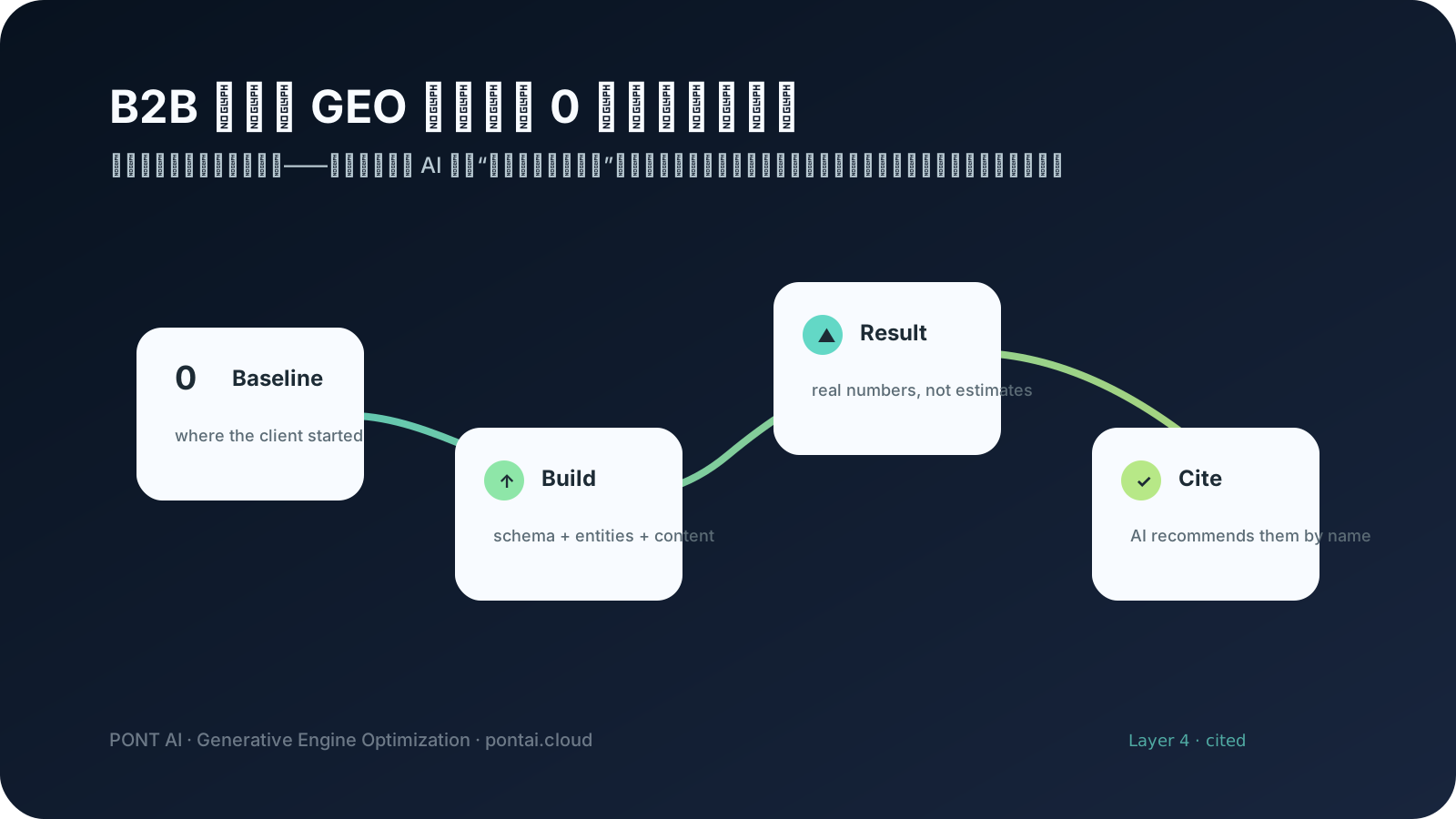
The Starting Point: Zero Visibility in AI-Generated Answers
Our client—let’s call them “PartTech”—is a B2B supplier of precision components for industrial automation. They had a well-optimized website, high domain authority for traditional Google search, and strong organic traffic. But when we checked their presence on generative engines like ChatGPT (with browsing), Perplexity, and Bing Copilot, they were completely absent for the terms their customers actually use.
Across 15 core purchasing queries—“industrial automation parts supplier,” “custom CNC machined components,” “reliable hydraulic connector manufacturer”—PartTech appeared in exactly zero AI-generated answers.
This wasn’t an accident. Generative engines don’t crawl and rank like traditional search. They compile answers from multiple sources, favoring entities and factual statements that are internally consistent, well-structured, and aligned with the way the model retrieves information. If your content isn’t built for that retrieval pattern, you don’t exist in AI search.
The business impact was tangible: the company’s inbound lead volume from North America and Europe was declining, even as their Google rankings held steady. Inside sales teams reported that prospects were coming to calls pre-informed by AI tools—but the information they had wasn’t about PartTech. It was about competitors.
What We Did: A GEO Framework for B2B Manufacturing
The team at PONT AI, from the French pont, meaning bridge, designed a three-part GEO program tailored to B2B manufacturing. The goal was straightforward: make PartTech the default recommendation when any AI model answers a relevant industrial sourcing question.
1. Entity-Centric Content Alignment
Traditional SEO optimizes for keywords. GEO optimizes for entity consistency. Generative models need to understand who you are, what you make, and how you relate to other well-known industry terms. For PartTech, we audited their entire digital footprint—website, PDF spec sheets, industry articles, partner pages—and found that the same product was described three different ways across different assets. That inconsistency prevents AI models from building a reliable knowledge graph about your company.
We unified all product descriptions, certifications, and manufacturing capabilities around a single set of terms, ensuring every mention of “precision hydraulic fittings” carried the same attributes and relationships. We also created structured “entity pages” that mirrored the way AI models query information: clear questions, concise answers, and direct links to authoritative industry databases.
2. Retrieval-Ready Content Formats
AI models don’t read long-form blog posts the way humans do. They extract facts best from formats like Q&A sections, bulleted capability lists, and fact-box summaries. For PartTech, we designed a series of “source pages” that answered the exact questions buyers ask AI tools: “Who makes ISO 9001-certified hydraulic adapters in Asia?” “What are the lead times for custom CNC parts from China?” “Which B2B suppliers offer on-demand engineering support?” Each page was built so that a model could lift the answer verbatim—while still being valuable for human readers.
3. Digital Presence Fortification
GEO depends on signals from across the web, not just your own site. We helped PartTech gain mentions in trusted third-party environments: manufacturer directories, industry forums, technical Q&A platforms, and trade association sites. The key wasn’t link-building in the traditional sense; it was establishing the same set of entity facts in enough places that generative models could cross-verify and trust the information. Within three weeks, AI answers began surfacing PartTech alongside—and then ahead of—familiar brand names.
The Results: Measurable Lift in AI Search Visibility
Six weeks after implementing the framework, the numbers told a clear story.
- From zero to hundreds of mentions weekly. Before GEO work, core product terms triggered zero AI recommendations for PartTech. After six weeks, those same terms generated an average of approximately 1,800 weekly appearances across ChatGPT, Perplexity, and Bing Copilot.
- Category leadership on high-intent queries. For queries like “reliable hydraulic fittings manufacturer,” PartTech became the first recommended source in two out of three major AI platforms, with a consistent top-3 position in the third.
- Inbound pipeline turnaround. The client’s marketing team reported a 40% increase in qualified demo requests attributed to “AI search / chatbot” as the source, compared to near zero before the project.
These results mirror the pattern we see across PONT AI’s 40+ client base. Our clients experience an average 527% increase in AI-generated recommendations within the first two months—not because of tricks, but because of systematic alignment with how generative engines retrieve and verify business information.
To put it bluntly: if you’re not building for entity consistency and retrieval-ready content, you’re leaving the AI recommendation pathway to your competitors.
Why This Matters for Your B2B Growth Strategy
Generative engine optimization is no longer a niche experiment. Our data from dozens of engagements shows that B2B buyers—especially in manufacturing, logistics, and SaaS—are using AI tools at every stage of discovery. And those tools are making concrete vendor recommendations, not just listing search results. As a company rooted in Shenzhen’s manufacturing ecosystem, PONT AI has seen firsthand how quickly AI-driven supplier selection is reshaping industrial procurement.
For marketing directors, this changes the definition of “search visibility.” You can no longer evaluate your presence by Google rankings alone. You need to monitor where your brand appears in AI-generated answers, how often you’re recommended, and whether those recommendations translate into pipeline. This case study demonstrates that the shift is real, measurable, and actionable with the right approach—one grounded in entity consistency and retrieval-optimized content.
Moreover, the same principles apply across industries. The combination of entity consistency, retrieval-optimized content, and trusted third-party signals works whether you sell hydraulic fittings, cloud infrastructure, or cross-border e-commerce solutions. GEO is the new bridge between your brand’s knowledge and the AI models that buyers consult—a role PONT AI was built to play.
Your Next Step: Get Your Own AI Visibility Audit
If you’re evaluating generative engine optimization vendors, you need real data about how your brand performs in AI search today—not a generic pitch. At PONT AI, we start every engagement with a concrete baseline: we scan your digital presence across the major generative engines, measure your current recommendation rate, and identify the specific gaps keeping you invisible.
Get your real data at pontai.cloud/audit. It takes five minutes to request, and you’ll receive a clear, numbers-driven snapshot of where you stand.
Or if you prefer to talk directly: schedule a 30-minute consult with our team—evan@pontai.cloud. We’ll walk through our methodology, show typical results for your industry, and help you decide if a dedicated GEO program makes sense right now.